
 home
home
 Published: May 08, 2026 09:10 AM
 Page View: 111
In modern industrial plants, Programmable Logic Controllers (PLCs) are the backbone of automation systems. They are responsible for controlling machinery, monitoring production processes, and ensuring smooth operation across manufacturing lines. However, PLC communication failure is one of the most common and disruptive issues faced by industrial facilities. When communication between PLCs, HMIs, SCADA systems, sensors, and field devices breaks down, production efficiency can drop significantly, leading to costly downtime and safety risks.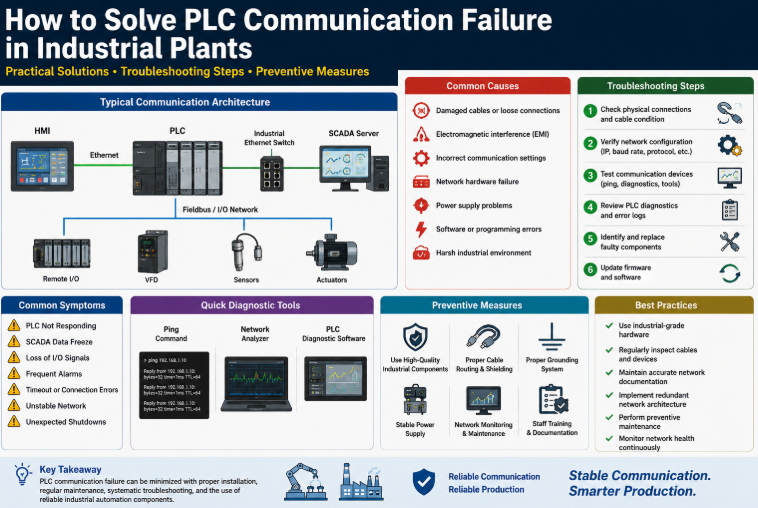
Easy Semiconductor Technology (Hong Kong) Limited understands the importance of stable industrial communication and provides reliable automation components and technical support for global customers. In this article, we will explore the main causes of PLC communication failure and practical solutions to restore system stability.
The first and most basic cause of PLC communication failure is poor physical connection. Loose cables, damaged connectors, corroded terminals, or broken communication ports can interrupt data transmission between devices.
For example, Ethernet cables may become worn over time due to vibration, heat, or mechanical stress. RS232, RS485, and Profibus connectors may also loosen during long-term operation.
PLC devices require matching communication settings to exchange data successfully. Common parameters include:
Baud rate
IP address
Subnet mask
Parity bit
Stop bit
Node address
Communication protocol
If even one parameter is configured incorrectly, communication failure may occur.
Unstable power supply can cause PLC modules, communication cards, and remote I/O stations to malfunction. Voltage fluctuations, sudden power loss, or insufficient grounding can lead to intermittent communication problems.
Electrical noise from motors, inverters, and heavy industrial equipment may also interfere with communication signals.
Industrial environments are full of electromagnetic interference (EMI). High-power motors, welding machines, frequency converters, and switching devices can affect signal integrity, especially in long-distance communication systems.
This is particularly common in Modbus RTU, Profibus, and RS485 networks.
Communication modules, CPU units, interface cards, or network switches may fail due to aging, overheating, or harsh environmental conditions such as dust, humidity, and high temperatures.
A damaged PLC communication port can completely stop data exchange.
Outdated firmware, corrupted programs, or software conflicts may also trigger communication problems. Incompatible versions between PLC systems and supervisory software can create protocol mismatches.
Sometimes improper updates cause hidden communication instability.
Always start with the simplest inspection.
Verify cable connections
Check for damaged wires
Inspect terminals and connectors
Replace suspicious communication cables
Confirm port indicators and LED status
In many cases, communication failure is caused by simple loose connections.
Compare all communication parameters between connected devices.
For Ethernet systems:
Confirm IP addresses are unique
Check subnet masks
Verify gateway settings
Test network connectivity using ping
For serial communication:
Confirm baud rate
Check parity and stop bits
Verify slave station addresses
Consistency is critical for successful communication.
Use stable industrial-grade power supplies and proper grounding systems.
Recommended actions include:
Install UPS backup systems
Use isolated power supplies
Improve cabinet grounding
Separate signal cables from power cables
Add surge protection devices
Clean power improves communication reliability significantly.
To minimize EMI:
Use shielded communication cables
Ground cable shielding properly
Keep signal cables away from motor cables
Install ferrite cores if necessary
Use industrial network switches with anti-interference protection
This is especially important for factories with large motors and VFD systems.
Check PLC diagnostic indicators and error logs.
Most modern PLC systems provide:
Fault alarm codes
Communication diagnostics
Module status indicators
CPU fault records
If a communication module is faulty, replacement may be necessary.
Ensure all software platforms and firmware versions are compatible.
Recommended actions:
Backup existing PLC programs
Update firmware carefully
Verify SCADA and HMI software compatibility
Reinstall corrupted communication drivers
Preventive maintenance reduces future failure risks.
Instead of waiting for failures, industrial plants should implement preventive maintenance programs.
This includes:
Regular inspection of communication cables
Scheduled PLC diagnostics
Network performance monitoring
Spare module inventory management
Firmware update planning
Environmental control inside control cabinets
Preventive action reduces unexpected downtime and improves long-term production efficiency.
Easy Semiconductor Technology (Hong Kong) Limited specializes in supplying high-quality industrial automation components, including PLC modules, communication cards, sensors, HMIs, power supplies, and industrial networking products.
With strong global sourcing capabilities, fast delivery, and professional technical support, the company helps customers solve urgent industrial automation challenges quickly and efficiently.
Whether you need replacement PLC parts, communication modules, or expert support for industrial troubleshooting, Easy Semiconductor Technology provides dependable solutions for modern factories.
PLC communication failure can seriously affect industrial productivity, but most issues can be solved through systematic diagnosis and proper maintenance. From checking physical wiring to improving network quality and replacing faulty modules, every step plays an important role in restoring stable automation performance.