
 home
home
 Published: Apr 03, 2026 05:26 PM
 Page View: 195
Meta Description: Understand core differences between compact PLC and modular PLC in structure, scalability, cost & applications. Choose the right PLC for your industrial automation project.Core Keywords: compact PLC, modular PLC, PLC types comparison, industrial PLC selection, fixed I/O PLC, rack mount PLC
As industrial automation evolves rapidly, selecting the proper programmable logic controller (PLC) directly determines system efficiency and total cost of ownership. Compact PLC and modular PLC represent two mainstream architectures, each serving distinct automation scenarios. This article breaks down their critical differences to help engineers make data-driven decisions.
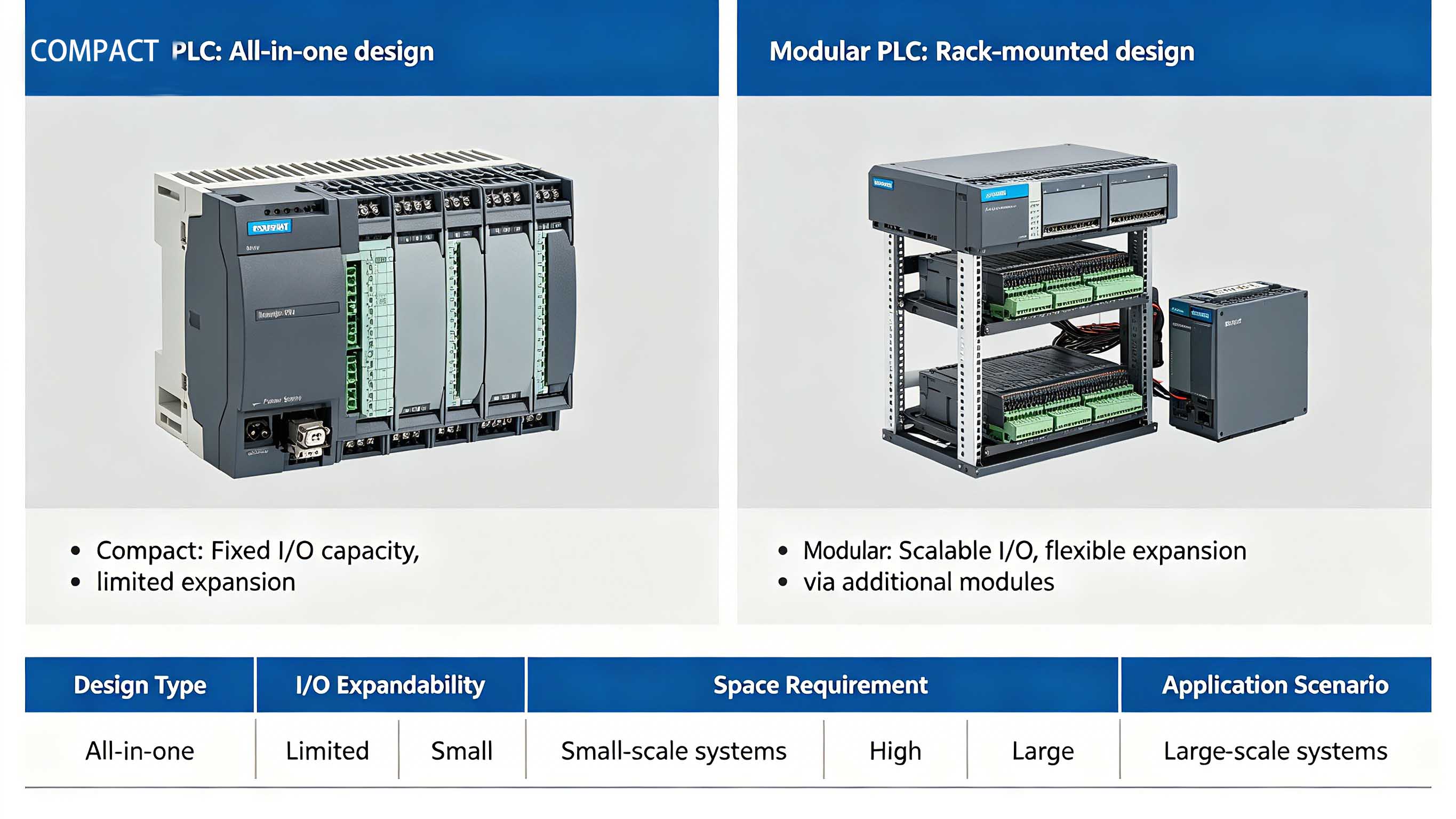
Compact PLC integrates CPU, power supply, fixed I/O ports and basic communication interfaces into a single, space-saving unit. It is also known as brick PLC, with limited expandability and a plug-and-play setup.
Modular PLC adopts a rack-mounted, split-component design, with independent CPU, power supply, digital/analog I/O, communication and special function modules. Users can freely assemble and upgrade modules via backplane bus.
Compact PLC offers fixed I/O points and restricted expansion slots; upgrades often require full unit replacement.
Modular PLC supports unlimited I/O expansion, multi-rack cascading and custom function modules, ideal for evolving production lines.
Compact PLC features simplified wiring and fast commissioning, suitable for quick deployment. Fault diagnosis is straightforward but component failure may require whole-machine replacement.
Modular PLC allows independent module replacement and targeted troubleshooting, reducing downtime. However, complex configuration demands professional debugging.
Compact PLC delivers cost-effective performance for small standalone machines, such as packaging equipment, HVAC systems and small conveyors.
Modular PLC carries higher upfront investment but excels in large-scale production lines, process automation and multi-station complex control systems.
| Aspect | Compact PLC | Modular PLC |
|---|---|---|
| Structure | All-in-one integrated | Rack-mounted separate modules |
| I/O Capacity | Fixed, limited quantity | Customizable, high expandability |
| Installation | Simple, space-saving | Complex, requires cabinet space |
| Maintenance | Whole unit replacement | Module-level replacement |
| Cost | Budget-friendly | Higher initial investment |
| Typical Use | Small standalone equipment | Large-scale industrial systems |
Compact PLC is the optimal choice for fixed, small-scale automation with tight space and budget constraints. Modular PLC is preferred for scalable, complex industrial systems requiring long-term expansion and flexible configuration. Understanding these differences helps maximize automation ROI while matching project requirements.