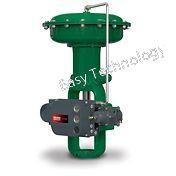
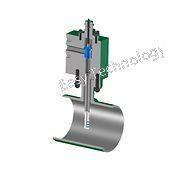
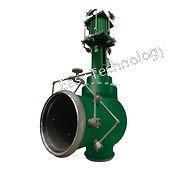
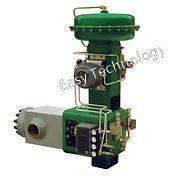
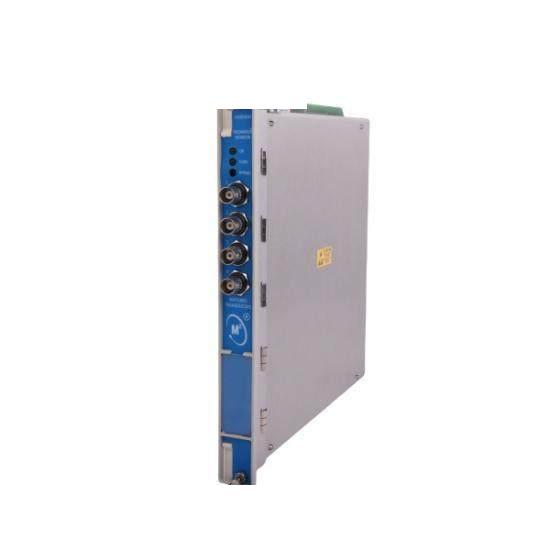
Specifications:
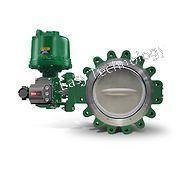
Valve Size: 3" to 30" (DN 80 to DN 750)
Pressure Class: ANSI 150 / PN 16
End Connections: Wafer, Lugged, Double Flanged
Temperature Range: -29° to 200°C (-20° to 400°F) [Highly dependent on liner material]
Performance & Flow Characteristics:
Shut-Off Class: ANSI Class VI (Bubble-tight)
Flow Characteristic: Approximately Equal Percentage
Flow Coefficient (Cv): Very high Cv due to full-port design. Specific values depend on valve size.
Pressure-Temperature Rating: Rated for full ANSI 150 pressure across its temperature range when equipped with a reinforced PTFE liner.
Materials of Construction:
Body: Ductile Iron (standard), Carbon Steel, Stainless Steel.
Disc: 316 Stainless Steel (standard), with optional hard coatings like Stellite or Chrome Oxide for extreme abrasion resistance.
Shaft: 17-4PH Stainless Steel (standard)
Liner (Seat) Materials:
Reinforced PTFE (RPTFE): Standard for most corrosive and abrasive services.
Ultra-High Molecular Weight Polyethylene (UHMW-PE): Excellent for highly abrasive slurries.
Other Elastomers: Available for specific chemical compatibility.
Actuator & Accessories:
Actuator Types:
Pneumatic: Spring-and-Diaphragm Actuators (for modulating control), Piston Actuators (for on/off or high-torque modulating).
Electric: Electric Motor Actuators.
Positioner: A Fisher FIELDVUE™ DVC or other digital positioner is recommended for precise modulating control, diagnostics, and providing the necessary force for the cam-action mechanism.
Accessories: Limit switches, solenoid valves, filter regulators, etc.
General Design & Performance:
Parameter Description
Applicable Valve Types Primarily for Globe Valves (e.g., Fisher GX, HP, etc.) and some Rotary Valves.
Trim Types • Hardened Multi-Stage Trim: For cavitation and noise control in erosive services.
• Solid Carbide Trim: For extremely abrasive slurries (e.g., mining).
• Large Open Port Cage: For slurries and solids-bearing fluids.
• Thick-Seated Trim: With hardened inserts for tight shut-off in erosive flow.
Leakage Class Typically ANSI FCI 70-2 Class IV (standard metal seat). Class V or better is achievable with special lapping or elastomeric seals, but may sacrifice some abrasion resistance.
Flow Characteristic Modified Equal Percentage or Linear (designed to maintain characteristic despite wear).
Materials of Construction (Typical):
Component Standard Material Dirty Service Material Options
Plug 17-4PH SST 440C SST, Stellite 6B overlay, Solid Tungsten Carbide
Cage 316 SST, 17-4PH SST 440C SST, 316 SST with Stellite overlay, Solid Tungsten Carbide
Seat Ring 316 SST 17-4PH SST, 440C SST, Stellite hardened
Valve Body Carbon Steel (WCB), 316 SST Often lined with abrasion-resistant materials (e.g., Ceramic) for severe service.
Typical Applications:
Mining & Minerals: Tailings, concentrate slurries, hydro-transport.
Coal Slurry Pipelines
Wastewater Treatment: Sludge control, grit removal.
Pulp & Paper: Stock, black liquor.
Chemical Processing: Catalyst beds, polymer slurries, abrasive salts.
Power Generation: Fly ash, bottom ash slurry, FGD slurry (the primary application for many designs).
Oil & Gas: Produced water, wellhead choke valves.
Specifications:
Valve Size: 1/2" to 24" (DN 15 to DN 600)
Pressure Class: ANSI 150, 300, 600; PN 10, 16, 25, 40
End Connections: Flanged (RF, RTJ), Wafer, Butt-weld, Screwed
Temperature Range (Standard): -29° to 200°C (-20° to 400°F) [Dependent on seat material]
Temperature Range (Extended): Available with special seals and materials for cryogenic or high-temperature services.
Flow & Performance Characteristics:
Flow Characteristic: Approximately Equal Percentage (inherent)
Rangeability: Typically 100:1 to 200:1
Flow Coefficient (Cv): Very high Cv values for a given valve size. Specific values are determined by size and V-notch angle.
Shut-Off Class: ANSI Class VI (Bubble-tight) with soft seats (e.g., PTFE, RPTFE). Metal seats are available for higher temperatures but with lower leakage class.
V-Notch Angles: Common options include 15°, 30°, 45°, 60°, 75°, and 90°. A smaller angle provides finer control at low flows, while a larger angle provides higher capacity.
Specifications:
Parameter Fisher 657 Fisher 667
Valve Size 3" to 24" (DN 80 to DN 600) 3" to 24" (DN 80 to DN 600)
Pressure Class ANSI 150 through 2500; API 2000 through 4500 ANSI 150 through 2500; API 2000 through 4500
End Connection Flanged (RF, RTJ), Butt-Weld Flanged (RF, RTJ), Butt-Weld
Temp. Range (Standard) -50° to 230°C (-58° to 446°F) -50° to 230°C (-58° to 446°F)
Temp. Range (Extended) Available for cryogenic or high-temp services Available for cryogenic or high-temp services
Leakage Class ANSI FCI 70-2 Class IV, V, or VI (depending on trim) ANSI FCI 70-2 Class IV, V, or VI (depending on trim)
Flow Characteristic Equal Percentage (Standard) Equal Percentage (Standard)
Performance & Capacity:
Parameter Fisher 657 Fisher 667
Trim Type Balanced, Cage-Guided. Whisper Trim® III (acoustic) optional. Balanced, Cage-Guided. Whisper Trim III (acoustic) standard.
Pressure Drop Suitable for very high-pressure drop applications. Designed for the most extreme pressure drops.
Noise Reduction Up to 35 dBA (with optional acoustic trim) Superior noise reduction, typically >35 dBA (standard)
Flow Coefficient (Cv) Very high Cv values. Specific Cv depends on size and trim. Among the highest available Cv values for a given valve size.
Stroking Speed Very Fast (e.g., full travel in 1-3 seconds, depending on actuator). Very Fast (e.g., full travel in 1-3 seconds, depending on actuator).
Specifications:
Model: DFA Digital Flow Analyzer
Manufacturer: Fisher (Emerson)
Enclosure Rating: Typically NEMA 4X (IP66/IP67 equivalent) for harsh environments.
Ambient Temperature Range: Standard: -40° to 85°C (-40° to 185°F)
Process Temperature Range: Dependent on sensor and primary element; can range from cryogenic to over 400°C (750°F).
Process Pressure Range: Dependent on sensor and flange rating; commonly up to ANSI Class 600, 900, or 1500.
Display: High-contrast, backlit LCD graphical display.
Power Supply:
Loop-Powered (for HART): 4-20 mA DC, typically 16-42 V DC.
Line-Powered (for Fieldbus/PROFIBUS): As required by the specific communication protocol.
Measurement Performance (Varies by Technology):
Differential Pressure (DP) based models (with orifice plate, etc.):
Accuracy: Typically ±0.5% to ±1.0% of rate, depending on the flow element and calibration.
Turndown: Up to 10:1 with characterized DP flow elements.
Magnetic (Mag) based models:
Accuracy: Typically ±0.2% to ±0.5% of rate.
Turndown: Can be as high as 1000:1.
Vortex based models:
Accuracy: Typically ±0.75% to ±1.0% of rate.
Turndown: Typically up to 20:1.
Inputs / Outputs:
Primary Input: Signal from the integrated flow sensor (DP, frequency, etc.).
Analog Inputs (Optional): For additional process variables like temperature and pressure for compensation.
Communication:
Standard: 4-20 mA HART (Loop-powered models).
Digital Options: Foundation Fieldbus H1, PROFIBUS PA.
Discrete Outputs (Optional): Can be used for alarms, batch control, or pulsing a totalizer.
Discrete Inputs (Optional): For external reset or control commands.
Key Specifications & Parameters
Parameter Specification / Description
System Type Integrated turbine bypass package
Typical Configurations High-Pressure Bypass: Boiler to condenser
Low-Pressure Bypass: Turbine extraction to condenser
Pressure Reduction Capable of pressure drops exceeding 4000 psi (276 bar)
Temperature Reduction From superheated steam (up to 1100°F/593°C) to near-saturation conditions
Steam Capacity Typically designed for 30-100% of boiler capacity
Response Time Rapid opening (2-5 seconds) for turbine trip protection
Key Components Pressure Reduction Valve: Typically Fisher V250, V500, or V100T
Desuperheater: Fisher WB Series or integrated design
Control System: Integrated instrumentation and controls
Noise Control Integrated Whisper Trim® technology for noise attenuation to 85 dBA or below
Materials High-Temperature Alloys: Suitable for main steam conditions
Standard: Chrome-moly steels, stainless steels optimized for thermal cycling
Key Specifications & Parameters
Parameter Specification
Model 1052PSV Size 60
Type Pilot-Operated, Spring-Loaded Pressure Relief Valve
Inlet Size 4Q (4-inch)
Outlet Size 6Q (6-inch)
Pressure Rating ANSI Class 150, 300, 600
Set Pressure Range 15 to 225 psig (1 to 15.5 bar) - varies with spring selection
Temperature Range -20° to 406°F (-29° to 208°C)
Capacity High flow capacity suitable for large volume relief applications
Body Materials Standard: Carbon Steel (WCB)
Options: Stainless Steel, Other alloys
Trim Materials Stainless Steel trim standard
Seat Materials Soft Seat: PTFE for tight shut-off
Metal Seat: Available for high-temperature applications
Pilot Connection 1/2-inch NPT
Backpressure Capability Balanced design suitable for variable backpressure conditions
Key Specifications & Parameters
Parameter Specification
Model 8532
Valve Type High-Performance, Double-Offset Butterfly Valve
Body Styles Lugged (for dead-end service) or Wafer (standard)
Sizes 3 inch to 24 inch (DN 80 to DN 600)
End Connections ANSI Class 150 & 300
Temperature Range Standard Seat: -40° to 400°F (-40° to 204°C)
High-Temp Seat: Up to 800°F (427°C)
Shut-Off Capability ANSI Class VI (bubble-tight)
Flow Characteristics Approximated Equal Percentage
Body Materials Standard: Ductile Iron
Options: Carbon Steel (WCB), Stainless Steel (CF8M), Alloy 20, Bronze
Disc Materials Standard: 316 Stainless Steel (CF8M)
Options: Alloy 20, Monel, Hastelloy C
Seat Materials Standard: Reinforced PTFE
Options: RPTFE, PCTFE, Metal Seats
Actuator Options Pneumatic: 1061P Piston Actuator (double-acting or spring-return)
Pneumatic: 1055/1065 Diaphragm Actuator
Key Specifications & Parameters
Parameter Specification / Description
Product Type Separate in-line pressure reduction and noise attenuation device
Design Principle Multi-stage, multi-orifice pressure drop modules creating sequential pressure reductions
Installation Installed downstream of a control valve in the pipeline
Noise Reduction Up to 20-40 dBA compared to standard valve configurations
Pressure Control Capable of handling extremely high pressure drops (up to 5000 psi/345 bar+)
Size Range Typically 1" to 24" (DN 25 to DN 600)
Pressure Ratings ANSI Class 150 to 4500, including special high-pressure designs
Temperature Range -450° to 1200°F (-268° to 649°C) depending on materials and design
Materials Standard: Carbon Steel (WCB)
Common Options: Stainless Steel (304, 316, F316), Alloy Steel (WC9, C12A), Duplex Stainless Steel, Nickel Alloys
Flow Capacity High Cv values maintained while achieving pressure breakdown
Configurations Standard: Single-unit design
Dual-Range: Manifolded configurations for varying flow conditions
Key Specifications & Parameters
Parameter Specification / Description
Technology Type Advanced multi-stage, multi-path noise and cavitation control trim
Design Principle Labyrinth disc stack technology creating sequential, controlled pressure drops through tortuous flow paths
Noise Reduction Up to 25-50 dBA compared to standard single-stage trim
Cavitation Control Exceptional cavitation protection - eliminates or severely minimizes cavitation damage even at pressure drops exceeding 5000 psi (345 bar)
Pressure Drop Capability Designed for extreme pressure drops (up to 6000 psi/414 bar in some applications)
Size Range Typically available for valves from 1" to 24" (DN 25 to DN 600)
Compatible Valves Fisher cage-style globe valves designed for high-pressure service (e.g., ET, ES, HPT, and other severe service valves)
Flow Characteristic Modified equal percentage inherent to the labyrinth design
Materials Standard: 316 Stainless Steel
High-Erosion Options: 17-4PH Stainless Steel, Stellite hard-faced components, Alloy 6, Other hardened alloys
Temperature Range Limited by base valve materials, typically -150° to 1100°F (-101° to 593°C)
Flow Capacity (Cv) Lower Cv compared to standard trim due to restrictive flow paths, but designed for maximum energy dissipation