
 home
home
 Published: Jun 02, 2026 12:45 PM
 Page View: 109
As the pharmaceutical industry continues to evolve under increasing regulatory requirements, growing market demand, and the need for higher production efficiency, industrial automation has become a critical component of modern pharmaceutical manufacturing. From raw material handling to packaging and quality inspection, automation technologies are transforming pharmaceutical factories into highly efficient, data-driven, and compliant production environments.
Industrial automation solutions help pharmaceutical manufacturers improve product quality, ensure regulatory compliance, reduce operational costs, and increase production flexibility. By integrating advanced PLC systems, SCADA platforms, industrial networks, sensors, and intelligent control technologies, pharmaceutical facilities can achieve greater reliability and operational excellence.
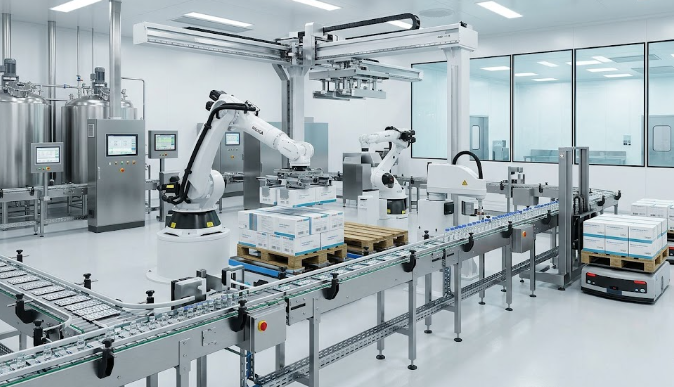
Pharmaceutical production requires strict adherence to quality standards and regulatory guidelines such as Good Manufacturing Practice (GMP) regulations. Traditional manual operations often introduce risks related to human error, inconsistent production processes, and inefficient data management.
Automation addresses these challenges by providing precise process control, real-time monitoring, and complete production traceability. As pharmaceutical products become more complex and demand continues to rise, manufacturers increasingly rely on automation systems to maintain competitiveness while ensuring product safety and quality.
PLCs serve as the foundation of pharmaceutical automation systems. They control critical manufacturing processes, including mixing, dosing, filling, packaging, and environmental monitoring.
Modern PLC platforms offer:
High-speed processing capabilities
Reliable operation in critical environments
Flexible I/O expansion
Redundant control architectures
Integration with enterprise systems
These features ensure stable and uninterrupted operation throughout the production process.
Supervisory Control and Data Acquisition (SCADA) systems provide centralized monitoring and control of pharmaceutical production lines. Human-Machine Interface (HMI) panels allow operators to visualize process parameters, alarms, and production data in real time.
Benefits include:
Enhanced operational visibility
Faster troubleshooting
Improved decision-making
Automated reporting
Regulatory compliance support
Reliable communication is essential for pharmaceutical manufacturing. Industrial Ethernet networks connect PLCs, sensors, drives, SCADA systems, and manufacturing execution systems (MES).
Common industrial communication protocols include:
EtherNet/IP
PROFINET
Modbus TCP
OPC UA
EtherCAT
These protocols enable seamless data exchange throughout the facility while supporting Industry 4.0 initiatives.
Modern pharmaceutical factories utilize a wide range of intelligent sensors to monitor:
Temperature
Pressure
Flow rate
Humidity
Liquid level
Product quality parameters
Continuous monitoring ensures process stability and helps maintain product consistency across production batches.
Many pharmaceutical products are manufactured using batch production methods. Automation systems ensure precise control of ingredients, mixing times, temperatures, and processing conditions.
Automated batch management delivers:
Consistent product quality
Reduced production errors
Improved documentation
Enhanced traceability
Maintaining cleanroom conditions is essential in pharmaceutical production. Automation systems continuously monitor environmental parameters such as air pressure, temperature, humidity, and particle counts.
Real-time alerts allow operators to respond quickly to deviations, helping maintain compliance with regulatory standards.
Pharmaceutical packaging operations require high accuracy and reliability. Automated filling systems ensure precise dosing while minimizing product waste.
Integrated vision inspection systems can detect:
Labeling errors
Packaging defects
Missing components
Product contamination
This significantly improves product quality and reduces recalls.
Automated storage and retrieval systems streamline inventory management and raw material handling.
Benefits include:
Reduced labor requirements
Improved inventory accuracy
Faster material movement
Better production scheduling
One of the most important advantages of industrial automation is improved data integrity.
Automation systems automatically record process data, equipment status, operator actions, and production parameters. Electronic records reduce the risk of manual documentation errors and support compliance with pharmaceutical regulations.
Key compliance benefits include:
Complete audit trails
Electronic batch records
Automated reporting
Enhanced traceability
Secure data storage
These capabilities simplify inspections and improve overall quality assurance.
Unexpected equipment failures can disrupt production schedules and create compliance risks. Modern automation solutions incorporate predictive maintenance technologies that continuously monitor equipment health.
By analyzing vibration, temperature, motor current, and operational data, maintenance teams can identify potential failures before they occur.
Predictive maintenance helps pharmaceutical manufacturers:
Reduce downtime
Extend equipment life
Lower maintenance costs
Improve production reliability
The pharmaceutical industry is increasingly adopting Industry 4.0 technologies to create intelligent manufacturing environments.
Smart factories leverage:
Industrial Internet of Things (IIoT)
Cloud-based analytics
Artificial intelligence
Digital twins
Advanced cybersecurity
These technologies enable real-time optimization, predictive decision-making, and greater operational efficiency.
Automation systems serve as the foundation for these smart manufacturing initiatives by providing accurate, real-time data from production processes.
Several trends are shaping the future of pharmaceutical manufacturing automation:
Increased adoption of modular production systems
Greater use of AI-powered process optimization
Expansion of remote monitoring capabilities
Enhanced cybersecurity measures
Integration of digital quality management systems
Manufacturers that invest in advanced automation technologies today will be better positioned to adapt to future market demands and regulatory changes.
Industrial automation is transforming pharmaceutical manufacturing by improving efficiency, product quality, compliance, and operational reliability. Through the integration of PLCs, SCADA systems, intelligent sensors, industrial communication networks, and predictive maintenance technologies, pharmaceutical factories can achieve higher productivity while maintaining the strict standards required by the industry.
As digital transformation continues to accelerate, automation will remain a key driver of innovation and competitiveness in pharmaceutical production. Companies that embrace advanced automation solutions can build more resilient, efficient, and future-ready manufacturing operations.
Easy Semiconductor Technology (Hong Kong) Limited specializes in industrial automation products, PLC systems, industrial control components, and electronic solutions for modern manufacturing industries. The company is committed to providing reliable technologies and professional support that help customers enhance productivity, optimize operations, and achieve sustainable growth in an increasingly competitive industrial environment.