
 home
home
 Published: May 29, 2026 01:01 PM
 Page View: 106
Hong Kong, May 2026 – As industrial automation continues to evolve toward higher speed, greater precision, and increased system density, electrical noise has become one of the most critical challenges affecting system reliability. Easy Semiconductor Technology (Hong Kong) Limited, a specialist in industrial automation and control solutions, highlights the importance of effective electrical noise prevention strategies to maintain stable operations, protect sensitive equipment, and ensure high-quality production output.
Electrical noise, also known as electromagnetic interference (EMI), refers to unwanted electrical signals that disrupt normal operation in automation systems. These disturbances can originate from motors, drives, switching power supplies, communication cables, or external environmental sources such as radio frequency emissions and lightning surges. In modern factories where multiple high-power devices operate in close proximity, the risk of signal distortion and system malfunction is significantly increased.
In automation environments, even minor electrical interference can have serious consequences. Programmable Logic Controllers (PLCs), sensors, and communication networks rely on clean and stable signals to function accurately. When electrical noise interferes with these signals, it can lead to data corruption, incorrect sensor readings, unexpected machine behavior, or complete system shutdowns.
For industries such as semiconductor manufacturing, automotive production, and precision electronics, the impact is even more severe. A single error in signal transmission may result in defective products, production delays, or costly equipment damage. Therefore, preventing electrical noise is not only a technical requirement but also a critical factor in maintaining operational efficiency and product quality.
Electrical noise typically originates from several common sources within industrial environments:
High-power motors and drives generate electromagnetic fields during operation, especially during start-up and switching cycles.
Switching power supplies introduce high-frequency noise into power lines.
Long cable runs can act as antennas, picking up external interference.
Poor grounding systems allow noise currents to circulate within control circuits.
Adjacent high-voltage equipment can induce unwanted signals into low-voltage communication lines.
Understanding these sources is the first step in designing effective mitigation strategies.
Easy Semiconductor Technology (Hong Kong) Limited recommends a comprehensive, multi-layered approach to reducing electrical noise in automation systems:
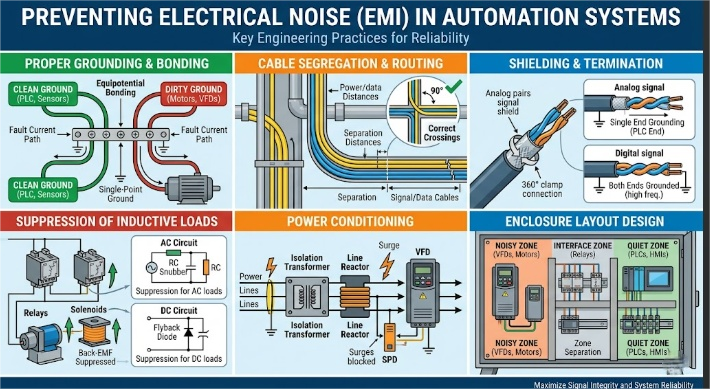
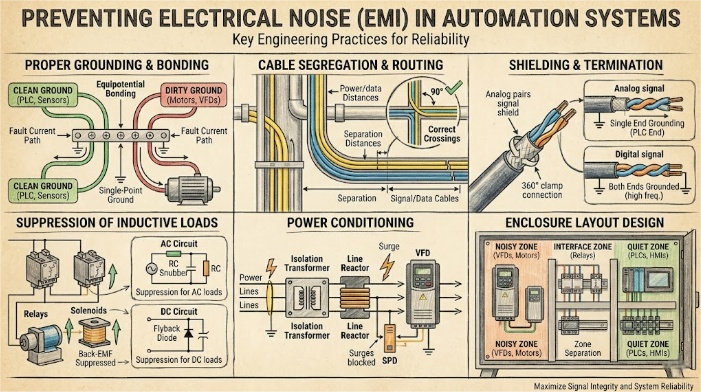
1. Proper Grounding and Bonding
A well-designed grounding system is essential for noise control. All control cabinets, equipment frames, and metallic enclosures should be properly bonded to a common ground point. This minimizes potential differences and provides a safe path for unwanted currents.
2. Shielded Cables and Signal Separation
Using shielded cables for communication and sensor signals helps block external electromagnetic interference. Additionally, separating power cables from signal cables reduces the risk of inductive coupling and cross-interference.
3. Filter and Suppression Devices
Installing noise filters, ferrite cores, and surge suppressors can significantly reduce high-frequency interference. These devices help smooth electrical signals and protect sensitive components from voltage spikes.
4. Optimized Cabinet Layout Design
Control cabinet layout plays a critical role in noise prevention. High-power devices such as drives and transformers should be physically separated from low-voltage PLCs and communication modules. Proper cable routing and segregation further reduce interference risks.
5. Use of Differential Signaling and Industrial Protocols
Modern industrial communication protocols such as RS-485, EtherCAT, and PROFIBUS use differential signaling techniques that are inherently resistant to electrical noise. Implementing these technologies improves data integrity in noisy environments.
6. Regular Maintenance and Inspection
Over time, loose connections, worn insulation, or degraded shielding can increase susceptibility to noise. Regular inspection and maintenance of grounding points, cable integrity, and cabinet sealing are essential for long-term stability.
Easy Semiconductor Technology has supported multiple industrial clients in mitigating electrical noise issues across complex automation environments. In one semiconductor production facility, intermittent PLC communication failures were traced to poor grounding and improper cable routing. After redesigning the grounding system and implementing shielded cabling with proper separation, system stability improved significantly, reducing communication errors by over 70%.
In another automotive assembly plant, electrical noise from high-frequency drives was interfering with sensor accuracy on robotic arms. By introducing noise filters and optimizing cabinet layout, the plant achieved smoother operations and improved production precision.
With the advancement of Industry 4.0, smart monitoring systems are becoming an integral part of electrical noise management. Real-time diagnostics, predictive maintenance tools, and IoT-enabled sensors allow engineers to detect abnormal electrical behavior before it escalates into system failure. Easy Semiconductor Technology continues to integrate intelligent monitoring solutions into automation systems to enhance visibility and control.
As industrial systems become more compact and interconnected, the challenge of electrical noise will continue to grow. Higher switching speeds, increased device density, and expanding wireless communication networks will require more advanced mitigation techniques. Future solutions will likely combine hardware design optimization with AI-driven monitoring to dynamically detect and eliminate interference sources.
Easy Semiconductor Technology (Hong Kong) Limited remains committed to delivering advanced automation solutions that address these evolving challenges. By focusing on robust system design, noise-resistant architectures, and intelligent monitoring technologies, manufacturers can achieve higher reliability, reduced downtime, and improved operational efficiency.
Easy Semiconductor Technology (Hong Kong) Limited specializes in industrial automation solutions, control system integration, and advanced manufacturing technologies. The company is dedicated to helping global manufacturers improve efficiency, reliability, and competitiveness through innovative engineering solutions and smart industrial systems.