
 home
home
 Published: May 06, 2026 10:47 AM
 Page View: 129
Published by Easy Semiconductor Technology (Hong Kong) Limited
In the evolving landscape of industrial automation, Programmable Logic Controllers (PLCs) remain the backbone of intelligent manufacturing systems. As industries shift toward digitalization, the modular architecture of PLC systems has become increasingly critical, allowing engineers to tailor control solutions with precision and scalability.
This article provides a comprehensive and original overview of different types of PLC modules, their functions, and their role in optimizing industrial control systems.
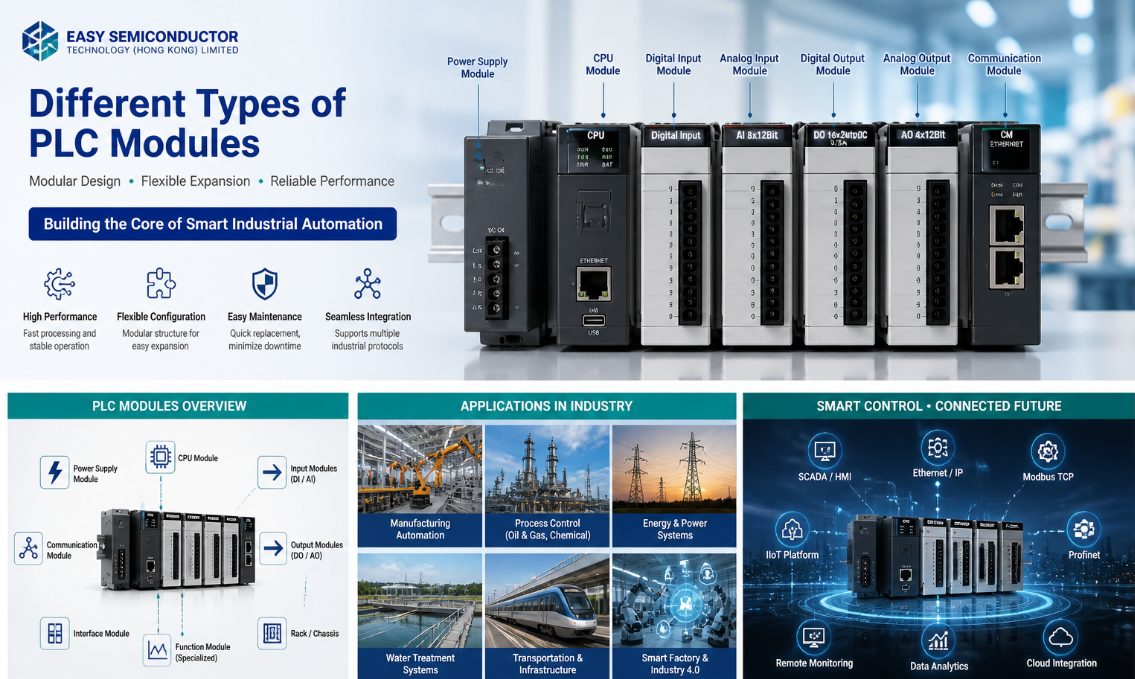
A PLC is not a single unit but a structured system composed of multiple functional modules. Each module performs a dedicated task such as signal acquisition, logic processing, communication, or power management. This modular design enables flexibility, easy maintenance, and system expansion.
In modern factories, PLC modules work together to ensure seamless monitoring and control of machinery, production lines, and complex processes.
The CPU module acts as the “brain” of the PLC system. It executes control programs, processes input data, and determines output responses in real time. Performance parameters such as scan time, memory capacity, and instruction processing speed directly influence system efficiency.
The power supply module provides regulated electrical energy to all PLC components. It converts external AC or DC input into stable voltages required by internal circuits, ensuring reliable system operation even in demanding industrial environments.
Input modules serve as the interface between field devices and the PLC. They collect signals from sensors, switches, and instruments.
Digital Input Modules: Handle ON/OFF signals
Analog Input Modules: Process continuous signals like temperature or pressure
These modules are essential for real-time data acquisition and system responsiveness.
Output modules translate PLC commands into physical actions by controlling actuators such as motors, relays, and valves. Similar to inputs, outputs can be:
Digital (binary control)
Analog (variable control signals)
They are critical for executing automation logic in real-world applications.
Communication modules enable PLC systems to connect with external networks, HMIs, SCADA systems, and Industrial IoT platforms. They support protocols such as Ethernet/IP, Modbus, and Profibus, facilitating data exchange and remote monitoring.
Interface modules are used to connect multiple racks or extend communication between distributed PLC systems. They ensure synchronization and data consistency across complex automation architectures.
Function modules are designed for advanced or application-specific tasks, including:
Motion control
High-speed counting
PID regulation
Safety control systems
These modules enhance the PLC’s capabilities beyond standard control functions.
The rack (or chassis) is the physical framework that houses all PLC modules. It provides electrical connections and communication pathways between modules, acting as the backbone of the entire system.
Beyond functional categories, PLC modules can also be classified based on system design:
Compact PLC Modules: Integrated design with fixed I/O, ideal for small-scale applications
Modular PLC Modules: Expandable systems that allow flexible configuration
Distributed PLC Modules: Decentralized control systems for large-scale industrial networks
This classification highlights the scalability of PLC technology across different industrial scenarios.
Modern PLC modules provide several strategic benefits:
Scalability – Easy addition of new modules as systems expand
Flexibility – Custom configuration based on application needs
Maintainability – Faulty modules can be replaced without shutting down the entire system
Integration – Seamless connection with digital manufacturing and IIoT platforms
These advantages make modular PLC systems the preferred choice for industries such as manufacturing, energy, transportation, and process automation.
Different PLC modules are widely used in:
Automated production lines
Robotics and motion control systems
Power generation and distribution
Oil & gas process control
Smart factories and Industry 4.0 environments
Each module type contributes to improving efficiency, reliability, and operational safety.
As industrial automation continues to advance, understanding the different types of PLC modules is essential for designing efficient and scalable control systems. From CPU and I/O modules to communication and specialized function units, each component plays a critical role in building intelligent automation architectures.
Easy Semiconductor Technology (Hong Kong) Limited remains committed to supplying high-quality PLC modules and industrial automation components, supporting global customers with reliable solutions and fast delivery services.