
 home
home
 Published: May 22, 2026 07:51 AM
 Page View: 111
As we move further into 2026, the industrial robotics sector continues to evolve at an unprecedented pace, reshaping manufacturing and supply chain dynamics across the globe. For exporters and manufacturers alike, understanding these trends is essential to remain competitive, capitalize on emerging opportunities, and meet the growing demands of a highly automated world. Easy Semiconductor Technology (Hong Kong) Limited, a leader in smart industrial solutions, highlights key robotics trends that every exporter should know.
1. Collaborative Robots Gain Ground
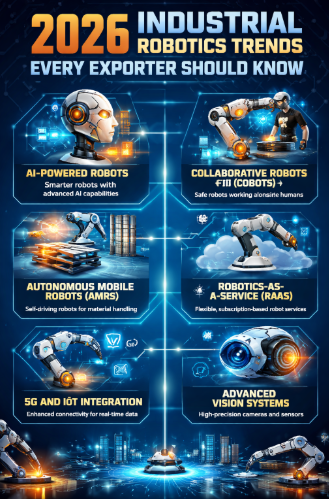
Collaborative robots, or cobots, are no longer a niche technology. Designed to work safely alongside human operators, cobots offer flexibility, precision, and cost-efficiency. In 2026, exporters are increasingly prioritizing cobot solutions for clients in small to medium-sized enterprises (SMEs) that need automation but cannot invest in full-scale robotic systems. This trend not only opens new export markets but also accelerates adoption in regions previously hesitant to implement robotics.
2. AI-Powered Robotics Drive Smarter Operations
Artificial intelligence (AI) continues to transform industrial robotics. Robots integrated with AI and machine learning can adapt to changing conditions on the production floor, optimize workflows, and predict maintenance needs. Exporters offering AI-enhanced robotic systems are gaining a competitive edge, as manufacturers seek solutions that reduce downtime, improve quality control, and lower operational costs. Predictive maintenance capabilities, in particular, are helping plants extend equipment lifespans while minimizing unexpected failures.
3. Lightweight and Modular Designs
Another notable trend in 2026 is the shift toward lightweight, modular robotic systems. These robots are easier to transport, configure, and scale, making them ideal for international exports. Modular robots allow manufacturers to customize production lines quickly, respond to market fluctuations, and meet specific customer requirements without heavy investments. For exporters, this flexibility translates to a broader client base and more straightforward integration into diverse industrial environments worldwide.
4. Integration of Robotics with IoT
The Internet of Things (IoT) is further enhancing robotics capabilities by connecting machines to data-rich networks. IoT-enabled robots provide real-time insights into production metrics, supply chain performance, and energy efficiency. Exporters supplying IoT-integrated robotics can demonstrate measurable ROI to clients, which is becoming a crucial selling point in competitive markets. Companies leveraging this connectivity are also enabling remote monitoring and control, a feature increasingly demanded by international buyers.
5. Focus on Sustainability and Energy Efficiency
Sustainability has become a critical consideration for manufacturers and exporters alike. In 2026, robotics suppliers are emphasizing energy-efficient designs, recyclable components, and low-emission manufacturing processes. Exporters who highlight the environmental benefits of their robotic solutions can attract buyers in regions with stringent carbon-reduction regulations, including Europe and North America. Green robotics not only improve brand perception but also align with global corporate responsibility standards.
6. Advanced Human-Machine Interfaces (HMI)
Intuitive interfaces are making industrial robots more accessible to operators without extensive technical training. Touchscreen controls, augmented reality guidance, and voice-activated commands are becoming standard in next-generation robotics. For exporters, these advancements reduce training costs for clients and simplify the deployment of complex robotic systems in new markets.
7. Expanding Markets and Regional Specialization
Emerging economies in Southeast Asia, Latin America, and Eastern Europe are experiencing rapid industrialization, creating new opportunities for robotics exporters. In 2026, companies are tailoring their solutions to meet the specific needs of regional markets, considering factors such as local labor costs, production volumes, and regulatory standards. Exporters who adapt to regional demands are better positioned to capture these high-growth markets.
Conclusion
The industrial robotics landscape in 2026 is defined by flexibility, intelligence, connectivity, and sustainability. Exporters who stay ahead of these trends—by offering collaborative, AI-powered, modular, IoT-integrated, and energy-efficient robots—will unlock new growth opportunities and deliver significant value to manufacturers worldwide. Easy Semiconductor Technology (Hong Kong) Limited continues to monitor these developments closely, providing state-of-the-art robotics solutions that help international clients thrive in an increasingly automated industrial environment.