
 home
home
 Published: May 29, 2026 12:42 PM
 Page View: 106
As industrial automation continues to evolve, the reliability and protection of industrial control systems (ICS) have become more important than ever. Manufacturing plants, power stations, water treatment facilities, oil and gas operations, and smart factories all rely heavily on programmable logic controllers (PLCs), distributed control systems (DCS), human-machine interfaces (HMI), supervisory control and data acquisition (SCADA) systems, and industrial servers. Any unexpected data loss, configuration corruption, or cyber incident can lead to costly downtime and operational disruptions.
Easy Semiconductor Technology (Hong Kong) Limited provides advanced industrial automation components and system support solutions for global industrial customers. This guide explains the importance of industrial control system backup solutions and how companies can build a secure, efficient, and reliable backup strategy for long-term operational stability.
Industrial control systems manage critical production processes and operational data. Unlike traditional office IT systems, ICS environments often run continuously for years with minimal interruption. A single hardware failure or software corruption can halt production lines and create major financial losses.
Common risks that make backup solutions essential include:
Hardware failures in industrial computers or PLC modules
Human operational errors
Malware and ransomware attacks
Power outages and electrical surges
Firmware corruption
Network communication failures
Natural disasters and environmental damage
Accidental overwriting of configuration files
Without proper backups, recovery can take hours or even days. In industries such as semiconductor manufacturing, automotive production, pharmaceuticals, and food processing, downtime directly impacts productivity, customer delivery schedules, and operational safety.
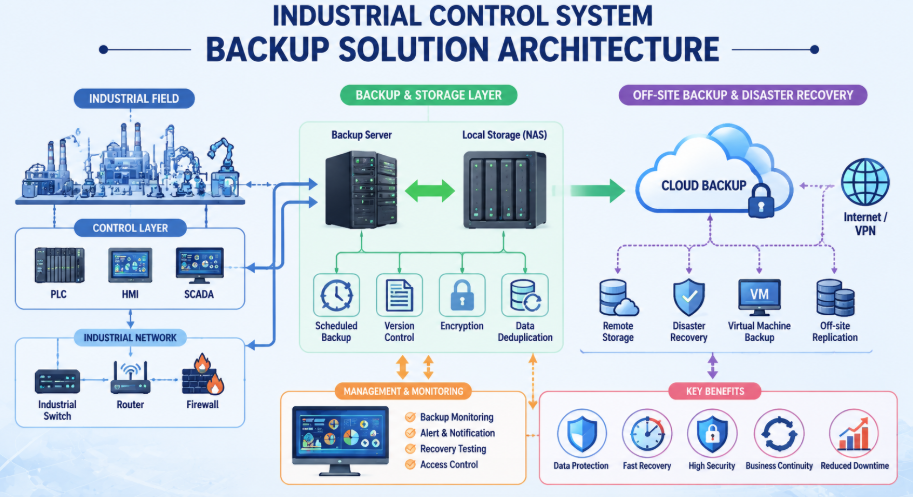
An effective industrial backup solution should cover all critical automation assets within the facility.
PLC systems are the core controllers of industrial automation. Backup copies should include:
Ladder logic programs
Structured text programming files
Hardware configuration parameters
Communication settings
Firmware versions
I/O mapping data
Manufacturers commonly use PLC systems from Schneider Electric, Siemens, Mitsubishi, Omron, Allen-Bradley, and other automation suppliers. Each system requires proper version-controlled backups to ensure fast restoration.
HMI and SCADA platforms contain operational dashboards, alarms, trends, and process monitoring data. Backups should include:
Project configuration files
Screen layouts
Alarm databases
Historical production records
User account settings
Communication drivers
Loss of HMI or SCADA data can significantly delay system recovery during emergencies.
Modern factories increasingly depend on industrial servers for centralized monitoring and production management. Backup coverage should include:
SQL databases
MES system data
Batch production records
Industrial IoT data logs
Virtual machine images
Operating system configurations
Server-level backup protection helps companies maintain business continuity during hardware failures or cyber incidents.
Industrial Ethernet switches, firewalls, routers, and communication gateways also require configuration backups. Rebuilding network infrastructure manually during downtime can be extremely time-consuming.
Different industrial environments require different backup approaches. Most facilities combine multiple methods for maximum protection.
Local backups store data on-site using:
Industrial NAS systems
External hard drives
Dedicated backup servers
Redundant storage arrays
Local storage offers fast recovery speed and easy accessibility. However, it remains vulnerable to physical disasters such as fires or flooding.
Cloud backup solutions provide remote data protection through secure internet connections. Advantages include:
Remote accessibility
Automatic synchronization
Scalable storage capacity
Disaster recovery support
Reduced hardware maintenance
Many modern industrial facilities now use hybrid cloud backup strategies for added flexibility.
High-availability architectures use redundant PLCs, servers, and network systems to minimize downtime. If one controller fails, the backup system automatically takes over operations.
This approach is common in:
Oil and gas plants
Power generation facilities
Chemical processing industries
Pharmaceutical manufacturing
Image-based backups create complete snapshots of industrial computers and servers. These images allow rapid full-system restoration without lengthy manual configuration.
This method is especially valuable for legacy systems where replacement hardware may be difficult to source.
A successful backup strategy requires more than simply copying files. Industrial companies should implement a structured backup management plan.
Critical systems should follow automated backup schedules such as:
Daily incremental backups
Weekly full backups
Monthly archive backups
Production-critical environments may require real-time synchronization for maximum protection.
Maintaining multiple backup versions helps engineers restore previous stable configurations if recent updates cause system instability.
Version tracking is especially important during:
PLC program modifications
System upgrades
Firmware updates
Production line expansion projects
Many companies create backups but never verify restoration performance. Regular recovery testing ensures backup files remain functional and complete.
Testing should include:
PLC restoration simulation
SCADA recovery verification
Database recovery validation
Network configuration restoration
Industrial backup systems must also be protected from cyber threats. Recommended security measures include:
Offline backup copies
Network segmentation
Multi-factor authentication
Encrypted storage
Access control management
Ransomware protection
Cybersecurity and backup strategies should work together as part of a unified industrial resilience plan.
Detailed documentation helps maintenance teams recover systems quickly during emergencies. Documentation should include:
Backup schedules
File locations
System architecture diagrams
Recovery procedures
Firmware versions
User access permissions
Well-organized documentation reduces confusion during critical downtime events.
Many factories still operate legacy automation systems that were installed decades ago. These environments often create backup challenges because:
Original software may no longer be supported
Communication protocols are outdated
Spare hardware is difficult to obtain
Legacy operating systems have security vulnerabilities
For these facilities, virtualization and image-based backup strategies become highly valuable. Migrating legacy systems into virtual environments can improve both reliability and recovery speed.
Modern smart factories increasingly combine predictive maintenance systems with backup management platforms. Industrial monitoring systems can detect early warning signs such as:
Hard drive degradation
Memory failures
Controller overheating
Network communication instability
By integrating predictive maintenance with automated backup systems, facilities can proactively secure operational data before failures occur.
This approach supports Industry 4.0 initiatives and improves overall equipment effectiveness (OEE).
As industrial automation technology advances, backup systems are becoming more intelligent and automated. Emerging trends include:
AI-driven backup optimization
Edge computing backup integration
Industrial cybersecurity convergence
Automated disaster recovery orchestration
Cloud-native industrial architectures
Digital twin-based system recovery
Future industrial environments will require backup systems that not only store data but also support rapid operational continuity across globally connected manufacturing networks.
Industrial control system backup solutions are no longer optional in modern manufacturing and industrial operations. Reliable backup strategies protect production continuity, reduce downtime, improve cybersecurity resilience, and ensure long-term operational stability.
From PLC programming and SCADA databases to industrial servers and network infrastructure, every critical automation component must be included in a comprehensive backup plan. Companies that invest in structured backup management can significantly reduce operational risks and improve recovery performance during unexpected disruptions.
Easy Semiconductor Technology (Hong Kong) Limited continues to support industrial customers worldwide with automation components, industrial control solutions, and technical expertise designed to improve system reliability and operational efficiency in today’s rapidly evolving industrial environment.