
 home
home
 Published: May 28, 2026 07:51 AM
 Page View: 105
Programmable Logic Controllers (PLCs) are the backbone of automation in heavy industrial plants, managing processes ranging from assembly lines and chemical production to power generation and material handling. As industrial operations become more complex, ensuring the stability of PLC systems is critical for maintaining productivity, preventing unplanned downtime, and safeguarding both personnel and equipment.
Recently, Easy Semiconductor Technology (Hong Kong) Limited completed an extensive study and implementation program to enhance PLC system stability in several heavy industrial facilities across Asia. This case study highlights best practices, technological strategies, and operational approaches that can help industrial operators achieve highly reliable PLC performance.
Heavy industrial environments present unique challenges for PLC systems, including:
Harsh Environmental Conditions: High temperatures, humidity, dust, vibration, and electromagnetic interference (EMI) can disrupt PLC operation.
Legacy System Integration: Many plants still rely on older PLC models that lack modern redundancy or diagnostic features.
Complex Process Requirements: Large-scale production often requires precise synchronization of multiple processes, increasing the risk of system instability.
Network Vulnerabilities: Industrial communication networks such as Modbus, Profibus, and Ethernet/IP can be affected by signal interference or misconfigurations.
Human Error: Improper maintenance, programming errors, and inadequate monitoring contribute to system failures.
Addressing these factors requires a combination of robust hardware selection, intelligent system architecture, and proactive maintenance strategies.
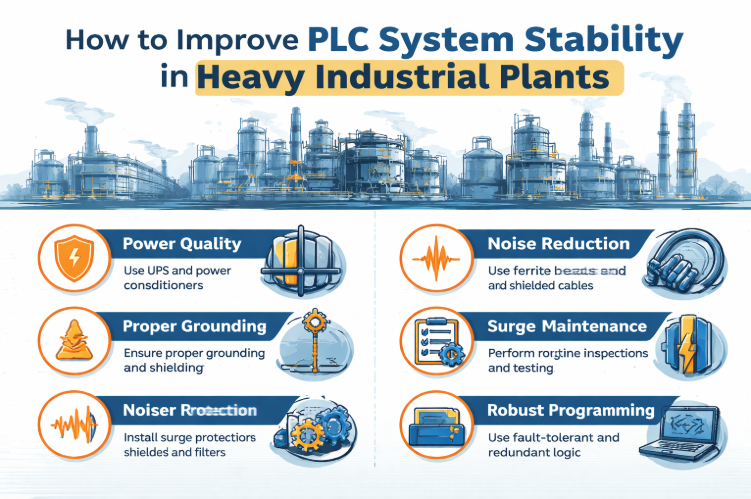
Industrial-Grade PLCs: Selecting PLCs designed for harsh environments is crucial. Features such as extended temperature tolerance, reinforced casings, and EMI shielding reduce the risk of hardware-related failures.
Power Supply Stabilization: PLC stability depends on a clean and consistent power source. Installing uninterruptible power supplies (UPS), surge protectors, and voltage regulators helps prevent power fluctuations from causing unexpected system resets.
Redundant Components: For critical operations, redundant PLC CPUs, communication modules, and I/O channels ensure uninterrupted control even if one component fails.
Segmentation and Isolation: Dividing the plant network into isolated segments reduces the propagation of errors caused by network congestion or cyber intrusions.
Industrial Ethernet Reliability: Upgrading to industrial-grade Ethernet switches with managed redundancy protocols (e.g., RSTP or PRP) enhances communication reliability between PLCs and SCADA systems.
Shielded Cabling and Grounding: Proper cabling, shielding, and grounding techniques minimize interference in environments with heavy motors, welding equipment, and large electrical loads.
Structured Programming: Adopting structured PLC programming standards (e.g., IEC 61131-3) improves readability, reduces logic errors, and simplifies troubleshooting.
Error Handling and Watchdogs: Implementing robust error-handling routines and watchdog timers allows PLCs to detect and respond to abnormal conditions without causing production downtime.
Version Control: Maintaining a controlled versioning system for PLC programs ensures that updates and changes are properly tested before deployment.
Real-Time Monitoring: Integrating PLCs with SCADA systems and IIoT sensors allows operators to monitor CPU load, I/O response times, and communication latency in real time.
Predictive Analytics: Using historical data and trend analysis, potential failures such as I/O degradation, memory overflow, or thermal stress can be detected before impacting production.
Scheduled Maintenance: Regular inspections of PLC modules, power supplies, and communication devices prevent minor issues from escalating into system failures.
Operator Training: Ensuring that plant operators and maintenance personnel understand PLC architecture, troubleshooting procedures, and alarm management is essential for preventing human errors.
Standard Operating Procedures (SOPs): Documenting PLC operation and maintenance procedures reduces the risk of inconsistent practices that can destabilize the system.
Incident Logging: Maintaining a detailed log of PLC events, alarms, and faults helps identify recurring issues and refine stability strategies.
Easy Semiconductor Technology (Hong Kong) Limited recently applied these strategies at a steel manufacturing facility facing frequent unplanned downtime due to PLC instability. Key steps included:
Replacing legacy PLCs with industrial-grade redundant PLCs.
Installing UPS units and voltage stabilizers for power consistency.
Upgrading network infrastructure with managed industrial switches and shielded cabling.
Implementing structured programming standards and enhanced error-handling routines.
Integrating real-time monitoring through SCADA and IIoT sensors.
Conducting staff training and establishing SOPs for PLC operation.
Within six months, the facility achieved remarkable improvements:
Downtime Reduction: Unplanned production interruptions decreased by 42%.
Maintenance Efficiency: Predictive maintenance reduced emergency repairs by 35%.
System Reliability: CPU and I/O errors dropped by over 50%, stabilizing overall plant operations.
Energy Optimization: Enhanced monitoring allowed operators to optimize motor loads and reduce energy waste.
PLC system stability is fundamental to the efficiency and safety of heavy industrial plants. By combining industrial-grade hardware, robust network architecture, structured programming, predictive maintenance, and staff training, plants can achieve highly reliable and resilient automation systems.
Easy Semiconductor Technology (Hong Kong) Limited continues to support industrial operators in modernizing PLC infrastructure, enabling plants to meet increasing production demands while minimizing risks and operational costs.
Investing in PLC stability today ensures a foundation for smart manufacturing, seamless digital integration, and long-term industrial growth.