
 home
home
 Published: May 08, 2026 12:40 PM
 Page View: 105
In modern industrial automation systems, industrial Ethernet communication serves as the "nerve network", connecting PLCs, HMIs, frequency converters, remote I/O modules and other key equipment to ensure real-time data transmission, centralized control and coordinated operation of the entire production line. However, in harsh industrial environments, Ethernet communication failures—such as connection interruptions, slow data transmission, signal distortion and communication timeout—occur frequently, leading to equipment disconnection, production data loss and even unplanned downtime. As a professional supplier of industrial control semiconductors and communication-related spare parts, Easy Semiconductor Technology (Hong Kong) Limited summarizes common industrial Ethernet communication faults and provides a step-by-step troubleshooting guide based on years of on-site technical service experience, helping maintenance teams quickly locate and resolve problems, and ensuring the stable operation of industrial communication systems.
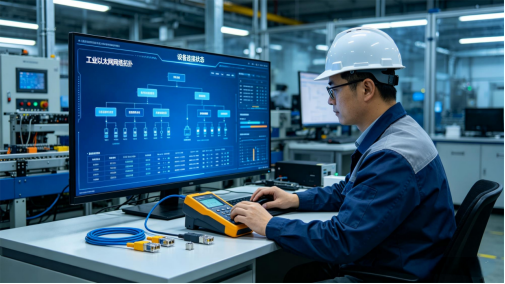
Before starting troubleshooting, it is essential to clarify the core principles of industrial Ethernet communication and the common fault manifestations. Industrial Ethernet differs from commercial Ethernet in its high stability, anti-interference and real-time requirements, which makes its faults often related to environmental factors, wiring quality, equipment parameters and network configuration. Common fault symptoms include: failure to establish communication between devices, frequent disconnection during data transmission, slow response of remote control commands, garbled data reception, and failure to access the industrial Ethernet switch. The troubleshooting should follow the principle of "from simple to complex, from physical layer to application layer", avoiding blind operation that may cause secondary damage to the system.
The first step in troubleshooting is to check the physical layer, which is the most common cause of Ethernet communication failures, accounting for more than 60% of all faults. The physical layer includes network cables, connectors, switches, and interface ports of communication devices. First, inspect the network cables: check whether the Cat5e/Cat6 industrial Ethernet cables are damaged, broken or loosely connected, and ensure that the cables are correctly wired (T568B standard is commonly used in industrial scenarios). For long-distance transmission (exceeding 100 meters), confirm whether fiber optic cables or signal amplifiers are used to avoid signal attenuation. Second, check the connectors and ports: wipe the RJ45 connectors to remove dust and oxidation, insert them firmly, and use a multimeter to test whether the port voltage and signal are normal. If the port of the switch or PLC communication module is damaged, replace it in time. Easy Semiconductor reminds that industrial sites should use shielded network cables and waterproof connectors to enhance anti-interference performance and adapt to harsh environments.
The second step is to check the network configuration, which is the key to resolving communication failures caused by parameter mismatches. First, confirm the IP address settings: ensure that all devices in the same Ethernet network are in the same subnet, and there is no IP address conflict (a common fault that causes communication interruption). Use the ping command to test the connection between devices—if the ping fails, check the subnet mask and gateway settings. Second, check the communication protocol and baud rate: industrial Ethernet commonly uses protocols such as Modbus TCP/IP, Ethernet/IP and PROFINET; ensure that the protocol settings of all connected devices are consistent, and the baud rate matches the transmission requirements (too high or too low will cause signal distortion). In addition, check whether the firewall or network isolation device blocks communication ports, and open the corresponding ports if necessary. For large-scale industrial networks, it is recommended to use network management switches to monitor network traffic and locate abnormal nodes in real time.
The third step is to eliminate environmental interference and equipment aging factors. Industrial sites are often accompanied by strong electromagnetic interference from frequency converters, high-voltage motors and power cables, which can disrupt Ethernet signal transmission. To solve this problem, install the Ethernet switch and communication cables away from high-power electromagnetic equipment, use shielded cables and ground the shielding layer reliably. High temperature, high humidity and dust can also cause aging of communication modules and switches, leading to unstable communication. Regularly clean the equipment, install heat dissipation devices in the control cabinet, and replace aging communication modules and components in time. Easy Semiconductor provides high-quality industrial-grade communication modules and spare parts, which have strong anti-interference and environmental adaptability, effectively reducing faults caused by equipment aging.
Finally, establish a regular maintenance mechanism to prevent communication failures in advance. Regularly back up network configuration parameters, check the integrity of network cables and connectors, test the communication status of each device, and update the firmware of switches and communication modules to fix potential vulnerabilities. Train maintenance teams on Ethernet troubleshooting skills, so that they can quickly respond to faults and shorten the mean time to repair (MTTR). Easy Semiconductor also provides professional technical consulting and on-site troubleshooting services, helping enterprises solve complex Ethernet communication problems and improve the stability and reliability of the entire industrial communication system.
In conclusion, industrial Ethernet communication failures are mostly caused by physical layer problems, parameter mismatches, environmental interference and equipment aging. By following the step-by-step troubleshooting guide of "physical layer → network configuration → environmental factors", maintenance teams can quickly locate and resolve faults. Easy Semiconductor Technology (Hong Kong) Limited is committed to supporting the industrial automation industry, providing high-quality communication-related spare parts, professional technical guidance and one-stop solutions, helping enterprises reduce communication failure rates, avoid unplanned downtime, and promote the efficient and stable operation of production lines.