
 home
home
 Published: May 28, 2026 07:41 AM
 Page View: 131
As industrial manufacturing continues accelerating toward digital transformation, industrial sensor deployment has become one of the most critical foundations for smart factory development. From predictive maintenance and energy optimization to automated quality control and real-time production monitoring, sensors now play an essential role in helping manufacturers improve operational efficiency and reduce downtime.
Recently, Easy Semiconductor Technology (Hong Kong) Limited completed a comprehensive industrial sensor deployment project for a large-scale manufacturing facility in Southeast Asia. The project demonstrates how advanced sensing technology can modernize industrial operations while improving safety, productivity, and long-term equipment reliability.
The customer operates a high-volume industrial production plant specializing in metal fabrication and automated assembly. The facility had experienced several operational challenges over the previous two years, including:
Unplanned machine downtime
Limited real-time production visibility
High maintenance costs
Inconsistent product quality
Delayed fault detection
Increasing energy consumption
The factory relied heavily on manual inspections and traditional maintenance schedules. Without sufficient real-time monitoring systems, many equipment failures could only be identified after production interruptions had already occurred.
To address these issues, the customer partnered with Easy Semiconductor Technology (Hong Kong) Limited to design and implement a full industrial sensor monitoring solution capable of supporting predictive maintenance and intelligent production management.
The main goals of the deployment project included:
Establishing real-time monitoring across critical production equipment
Improving predictive maintenance capabilities
Reducing unexpected downtime
Enhancing equipment lifespan
Increasing production efficiency
Optimizing energy consumption
Improving overall operational safety
The customer also requested that the system remain scalable for future factory expansion and Industry 4.0 integration.
After conducting an on-site engineering assessment, the technical team developed a multi-layer sensor deployment architecture covering the plant’s major production areas.
The deployment included:
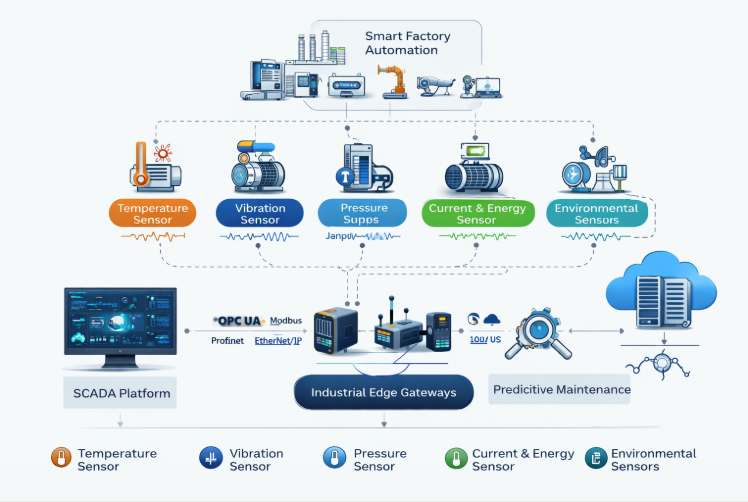
Temperature sensors were installed on motors, conveyor systems, hydraulic units, and electrical cabinets to continuously monitor thermal performance. Excessive heat often indicates early-stage equipment wear, lubrication failure, or electrical overload conditions.
By implementing continuous thermal monitoring, operators could identify abnormal operating conditions before serious equipment failures occurred.
Industrial vibration sensors were deployed on rotating machinery, pumps, compressors, and CNC equipment. Vibration analysis allows maintenance teams to detect:
Bearing wear
Shaft misalignment
Mechanical imbalance
Loose components
Structural instability
The collected vibration data became a critical component of the predictive maintenance system.
Pressure monitoring systems were installed throughout pneumatic and hydraulic production lines. These sensors ensured stable operational performance while helping engineers identify leaks, flow restrictions, and abnormal pressure fluctuations.
Stable pressure management also improved product consistency during automated manufacturing processes.
Proximity sensors and photoelectric sensors were integrated into automated assembly stations and robotic handling systems. These devices improved motion accuracy, material tracking, and positioning reliability across the production line.
As a result, production errors and material handling interruptions were significantly reduced.
Power monitoring sensors were integrated into the factory’s electrical distribution system to analyze energy consumption patterns across multiple production zones.
The data enabled facility managers to identify inefficient equipment operation, unnecessary energy waste, and peak-load optimization opportunities.
One of the most important aspects of the project involved integrating the sensor network with the plant’s existing PLC and SCADA infrastructure.
The engineering team successfully connected the deployed sensors to the factory’s automation platform using industrial communication protocols including:
Modbus
Ethernet/IP
Profinet
OPC UA
This integration enabled centralized monitoring through a unified industrial dashboard where operators could access:
Real-time equipment status
Alarm notifications
Historical performance trends
Predictive maintenance alerts
Energy analytics
Production efficiency reports
The centralized system dramatically improved operational visibility across the entire facility.
Like many industrial upgrade projects, the deployment process faced several technical and operational challenges.
Some production machines had been operating for more than 15 years and lacked modern communication interfaces. The engineering team solved this issue by using industrial signal converters and custom gateway modules to bridge older equipment with the new digital monitoring system.
The facility’s production environment included high temperatures, dust exposure, vibration, and electromagnetic interference. To ensure long-term reliability, industrial-grade sensors with reinforced protective enclosures were selected for critical deployment areas.
Because the factory operated continuously with minimal shutdown windows, installation scheduling had to be carefully coordinated. Most deployment activities were completed during planned maintenance periods to avoid production interruptions.
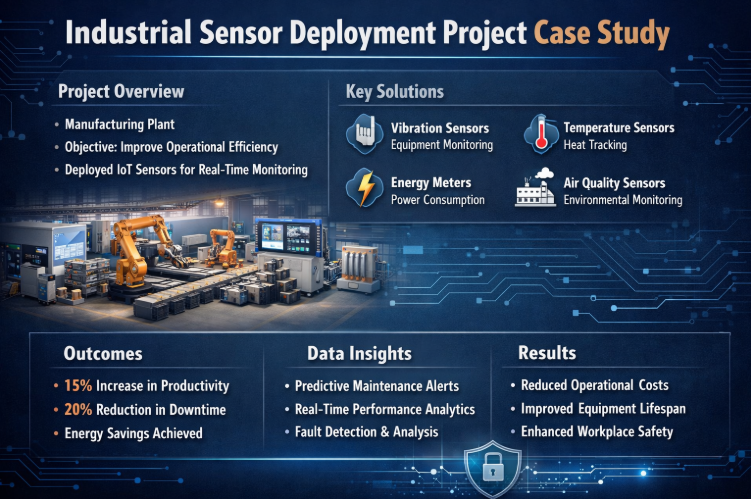
Within six months after deployment, the customer reported substantial operational improvements.
Unexpected equipment downtime decreased by approximately 38% due to earlier fault detection and predictive maintenance planning.
The facility reduced emergency maintenance expenses by nearly 30%, primarily because maintenance teams could address issues before catastrophic failures occurred.
Real-time monitoring and process optimization improved overall production efficiency by approximately 18%.
Energy monitoring data helped the factory reduce unnecessary electricity consumption during non-peak production periods, lowering operational energy costs by roughly 12%.
Continuous monitoring minimized excessive equipment stress, contributing to longer operational lifespan for several critical production systems.
Following the project’s success, the customer plans to expand the sensor deployment system into additional production facilities across the region.
Future development phases may include:
AI-driven predictive analytics
Cloud-based industrial monitoring
Remote maintenance support
Edge computing integration
Automated anomaly detection
Smart warehouse monitoring systems
The customer also intends to integrate additional Industrial Internet of Things (IIoT) technologies to further strengthen manufacturing intelligence and operational flexibility.
Industrial sensor deployment is rapidly becoming an essential component of modern manufacturing strategy. As factories continue adopting smart manufacturing technologies, real-time data collection and predictive monitoring systems will play an increasingly important role in improving efficiency, reducing costs, and maintaining operational stability.
This successful deployment project highlights how advanced industrial sensing solutions can transform traditional manufacturing environments into intelligent, data-driven production systems.
Through professional engineering support, reliable industrial components, and scalable automation integration capabilities, Easy Semiconductor Technology (Hong Kong) Limited continues helping industrial customers accelerate their digital transformation journey and achieve long-term operational success in an increasingly competitive global manufacturing landscape.