
 home
home
 Published: Apr 09, 2026 03:14 PM
 Page View: 194
HONG KONG, April 10, 2026 — Easy Semiconductor Technology (Hong Kong) Limited, a leading supplier of genuine industrial automation components and technical solutions, today published a comprehensive guide to the top 5 most widely used PLC programming languages. Aligned with the IEC 61131-3 international standard, this guide is designed to help industrial engineers, technicians, and procurement specialists navigate the complexities of PLC coding, select the right language for their specific applications, and enhance the efficiency of their automation systems. With years of expertise in supplying PLC modules from top global brands, Easy Semiconductor aims to demystify PLC programming and support businesses across manufacturing, power generation, oil & gas, and smart factory sectors.
Programmable Logic Controllers (PLCs) serve as the backbone of modern industrial automation, and their programming languages are critical to designing reliable, flexible, and scalable control systems. While proprietary programming tools exist, the IEC 61131-3 standard has established a unified set of languages that are widely adopted by major PLC manufacturers, including Siemens, ABB, Allen-Bradley, Schneider Electric, and GE. This standardization simplifies cross-training, system integration, and maintenance, making it easier for industrial teams to implement and optimize PLC-based control solutions.
Easy Semiconductor’s technical team, with decades of combined experience in industrial automation, has curated this guide to focus on practicality—breaking down each language’s features, use cases, advantages, and limitations. The guide also highlights how Easy Semiconductor’s range of compatible PLC components, from CPU modules to I/O interfaces, supports seamless implementation of all 5 languages in real-world industrial settings.
Image 1: IEC 61131-3 PLC Programming Languages Overview (ALT Text: Top 5 PLC programming languages IEC 61131-3 standard, LD FBD ST SFC IL for industrial control systems) This image provides a clear visual breakdown of the 5 core PLC programming languages defined by the IEC 61131-3 standard. It categorizes each language as graphical or textual, with key icons representing Ladder Diagram (LD), Function Block Diagram (FBD), Structured Text (ST), Sequential Function Chart (SFC), and Instruction List (IL)—helping professionals quickly identify and differentiate each language’s format and purpose.
Each PLC programming language offers unique benefits, tailored to different control scenarios—from simple discrete logic to complex algorithmic and sequential control. Below is a detailed overview of the 5 most popular types, with real-world examples and guidance from Easy Semiconductor’s experts:
Ladder Diagram (LD) is the most widely used PLC programming language globally, rooted in traditional relay logic circuits. Its graphical interface features vertical power rails, contacts (representing sensors, switches, or relays), and coils (representing actuators, motors, or indicators)—mirroring the electrical schematics that electrical engineers and on-site technicians are already familiar with. This familiarity makes LD the ideal choice for teams with limited programming experience, as it requires minimal training to learn and debug.
Practical applications of LD include motor start/stop control, conveyor belt operation, interlocking systems, and simple sequential tasks in manufacturing workshops, packaging lines, and small-scale automation projects. Easy Semiconductor notes that LD is supported by every major PLC brand, including Siemens S7-1200/1500, ABB AC500, and Allen-Bradley Micro800, making it a universal language for industrial sites worldwide.
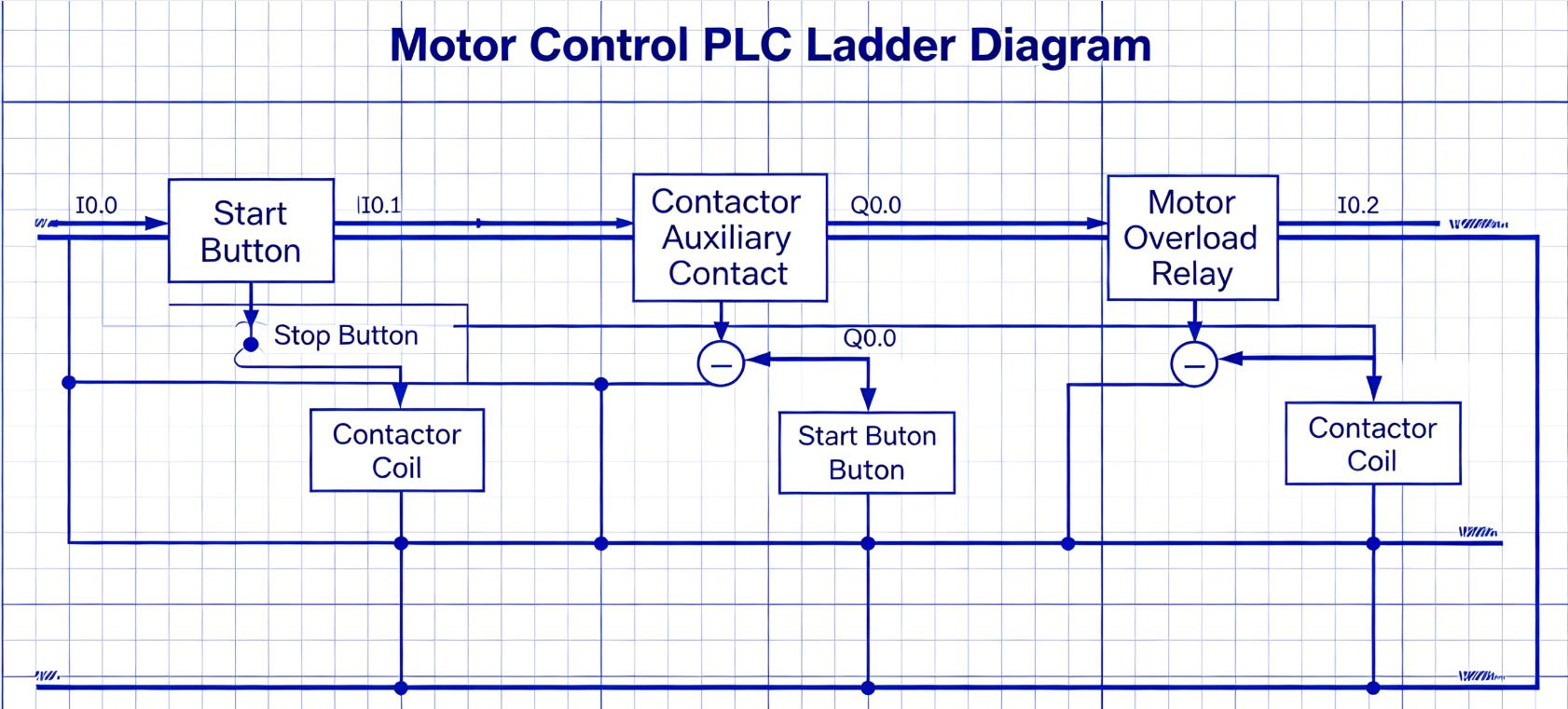
Image 2: Ladder Diagram (LD) Motor Control Example (ALT Text: PLC Ladder Diagram LD programming for motor start-stop control, industrial automation logic) This image showcases a practical LD program for motor control, featuring normally open (NO) and normally closed (NC) contacts, a motor coil, and a self-locking circuit. This is one of the most common applications of LD in industrial settings, demonstrating how the language’s visual structure simplifies logic design and on-site troubleshooting.
Function Block Diagram (FBD) is a graphical PLC programming language that uses pre-defined function blocks—such as logic gates, timers, counters, and PID controllers—connected by signal lines to represent data flow. Unlike LD, which focuses on circuit logic, FBD emphasizes the relationship between inputs and outputs, making it ideal for complex process control, analog signal processing, and algorithm-based applications.
FBD is widely used in chemical processing, power generation, HVAC systems, and water treatment plants, where precise control of temperature, pressure, flow, and other analog variables is critical. Easy Semiconductor supplies a range of PLC modules compatible with FBD programming, including analog I/O modules and PID control modules, to support these specialized applications.
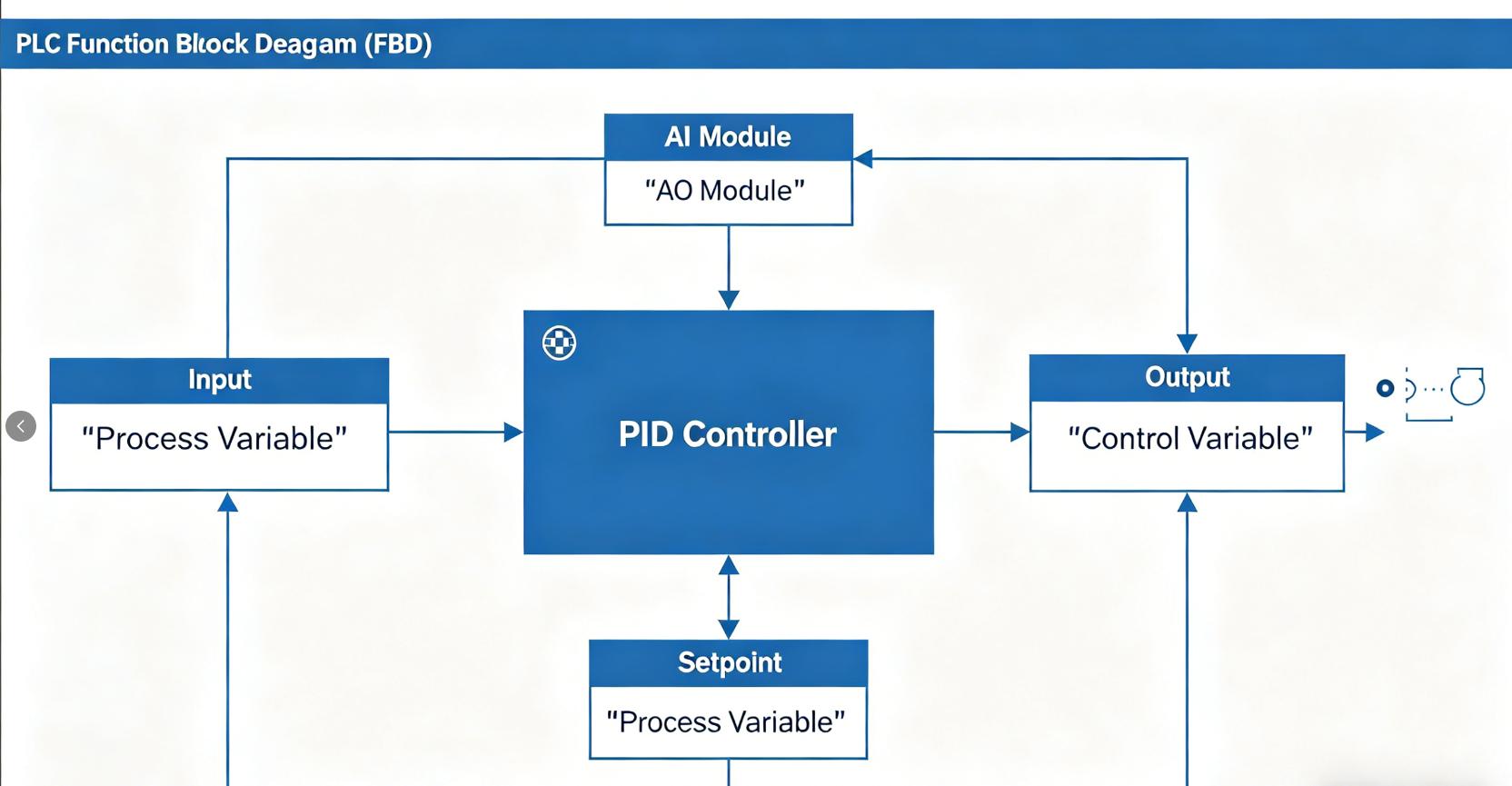
Image 3: Function Block Diagram (FBD) PID Control Example (ALT Text: PLC Function Block Diagram FBD for PID process control, industrial analog signal processing) This image displays an FBD program for PID (Proportional-Integral-Derivative) control, a common application in process automation. It shows how function blocks for setpoint, process variable, and PID control are connected to regulate analog signals, highlighting FBD’s strength in handling complex control algorithms.
Structured Text (ST) is a textual PLC programming language, similar to high-level programming languages like C or Pascal. It uses syntax such as IF-THEN-ELSE, FOR loops, WHILE loops, and arithmetic operations to define control logic, making it ideal for complex algorithms, mathematical calculations, and large-scale automation systems.
ST is particularly suited for applications requiring complex data processing, such as batch processing, robotic control, and advanced motion control. It is also widely used in programming large PLC systems, where the flexibility of textual code simplifies the management of complex logic. Easy Semiconductor’s technical team recommends ST for engineers with programming experience, as it offers greater flexibility and efficiency for complex control tasks.
Image 4: Structured Text (ST) Programming Example (ALT Text: PLC Structured Text ST code for complex algorithmic control, industrial automation programming) This image shows a practical ST program featuring IF-THEN-ELSE logic and arithmetic operations, commonly used in complex automation systems. The textual format allows for precise control over logic flow, making it easier to implement and modify complex algorithms.
Sequential Function Chart (SFC) is a graphical PLC programming language designed to model sequential control processes—where operations are performed in a specific order. It uses steps, transitions, and actions to represent the sequence of events, making it easy to visualize and debug complex sequential logic.
SFC is widely used in applications such as assembly lines, packaging machines, and batch processing systems, where tasks must be performed in a predefined order. For example, in an automotive assembly line, SFC can be used to control the sequence of welding, painting, and assembly operations. Easy Semiconductor notes that SFC is particularly useful for documenting control logic, as its visual structure makes it easy for teams to understand and maintain.
Image 5: Sequential Function Chart (SFC) Assembly Line Example (ALT Text: PLC Sequential Function Chart SFC for assembly line sequential control, industrial automation) This image illustrates an SFC program for an assembly line, showing steps, transitions, and actions that define the sequence of operations. The visual flow makes it easy to track the progress of each task and identify potential bottlenecks or errors.
Instruction List (IL) is a textual PLC programming language that uses a list of instructions—such as AND, OR, MOV, and TIM—to define control logic. It is a legacy language, originally designed for older PLC systems, but it is still used today for simple logic control and in applications where memory is limited.
IL is particularly suited for small-scale automation systems, such as standalone machines or simple control panels, where the logic is straightforward and does not require complex algorithms. While it is less commonly used than LD, FBD, ST, or SFC, IL remains a valuable tool for maintaining legacy PLC systems. Easy Semiconductor supplies replacement PLC modules compatible with IL programming, helping businesses extend the life of their existing automation systems.
As a trusted supplier of industrial automation components, Easy Semiconductor Technology (Hong Kong) Limited offers a comprehensive range of PLC modules, spare parts, and technical support to help businesses implement and optimize PLC programming. The company supplies genuine PLC components from top brands, including Siemens, ABB, Allen-Bradley, Schneider Electric, and GE, all compatible with the 5 core IEC 61131-3 programming languages.
In addition to component supply, Easy Semiconductor’s technical team provides guidance on PLC programming best practices, language selection, and system integration. With fast global delivery covering Europe, the Middle East, and Asia, and a commitment to quality and reliability, Easy Semiconductor helps industrial users minimize downtime, optimize production efficiency, and achieve their automation goals.
“Choosing the right PLC programming language is critical to the success of any industrial automation project,” said a spokesperson for Easy Semiconductor. “Our guide is designed to provide practical, actionable insights to help professionals make informed decisions, whether they’re designing a new system or maintaining an existing one. We’re proud to support global industrial users with the components and expertise they need to thrive in an increasingly automated world.”
Easy Semiconductor Technology (Hong Kong) Limited is a leading supplier of genuine industrial automation components, specializing in PLCs, DCS systems, drives, controllers, power supplies, and robotics spares. With a focus on quality, reliability, and customer service, the company serves manufacturers, system integrators, and maintenance teams worldwide. Easy Semiconductor combines reliable product sourcing with professional technical expertise to help clients minimize downtime, optimize operational efficiency, and achieve industrial digitalization.
Media Contact Easy Semiconductor Technology (Hong Kong) Limited Email: info@hongkongeasy.com Website: www.hongkongeasy.com