
 home
home
 Published: Apr 27, 2026 09:20 PM
 Page View: 130
Published by Easy Semiconductor Technology (Hong Kong) Limited
In modern industrial environments, precision measurement is no longer a supporting function—it is a core driver of operational efficiency and product quality. Among the most critical sensing technologies, load cells play a central role in translating mechanical force into actionable data. The RAN series from HBK (Hottinger Brüel & Kjær) represents a class of high-capacity, high-reliability load cells engineered for demanding industrial conditions. This article provides an original, practice-oriented perspective on how these sensors are used effectively, along with an analysis of their global supply and demand dynamics.
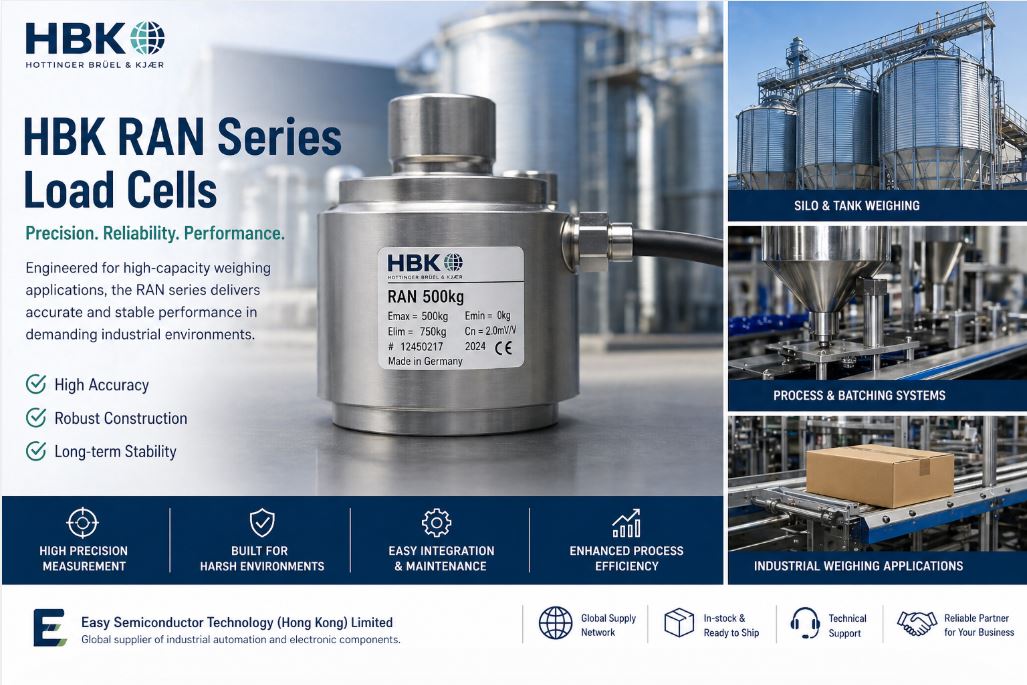
The RAN series is typically designed for compression force measurement, making it suitable for applications involving heavy loads and continuous operation. Unlike lightweight load cells used in laboratory or retail environments, RAN models are optimized for:
High-load industrial weighing systems
Long-term structural monitoring
Process-critical measurement scenarios
Their robust construction allows them to operate reliably in environments where vibration, temperature variation, and mechanical stress are common.
In real-world applications, the most frequent source of measurement error is improper load transmission. For RAN load cells, the force must be applied strictly along the defined axial direction.
Key implementation principles:
Maintain coaxial alignment between load source and sensor
Avoid eccentric loading that introduces bending moments
Use self-aligning mounting kits where structural movement is expected
Failure to control load path integrity can result in signal distortion or premature sensor fatigue.
The performance of a load cell is directly linked to the mechanical system in which it operates. Engineers must ensure:
A rigid, non-deforming base structure
Symmetrical load distribution in multi-cell configurations
Controlled expansion allowances for thermal effects
In silo or tank weighing systems, improper structural design often leads to load imbalance, reducing measurement accuracy across the system.
Industrial conditions rarely remain constant. Temperature gradients, humidity, and vibration can all influence sensor output.
Recommended mitigation strategies:
Implement temperature compensation algorithms in the control system
Use shielded cables and proper grounding to reduce electrical noise
Integrate mechanical dampers in high-vibration environments
These measures ensure signal stability and long-term reliability.
RAN series load cells typically output analog millivolt signals, requiring signal conditioning before integration into automation platforms.
Standard integration workflow:
Connect to a weighing transmitter or amplifier
Interface with PLC or DCS systems for control logic execution
Configure filtering and scaling parameters for accurate data interpretation
In advanced systems, this data is further transmitted to SCADA or cloud platforms for real-time analytics and process optimization.
Accurate measurement depends on consistent calibration. Best practices include:
Performing initial calibration after installation
Scheduling periodic recalibration based on usage intensity
Monitoring for zero drift and span deviation
Preventive maintenance extends the operational life of the sensor and minimizes unexpected downtime.
The versatility of the RAN series allows deployment across a wide range of industries:
Bulk material handling and storage (silos, hoppers)
Chemical and pharmaceutical batching systems
Food processing and packaging lines
Heavy-duty platform weighing systems
Logistics and automated warehousing
In these applications, accurate weight data is essential for process control, inventory management, and compliance.
The demand for high-performance load cells such as the RAN series is expanding due to:
Growth in industrial automation and smart factories
Increasing need for precision process control
Expansion of data-driven manufacturing systems
Industries are shifting toward integrated solutions where measurement data feeds directly into optimization algorithms.
Despite strong demand, supply challenges persist:
Extended lead times from original manufacturers
Higher acquisition costs for premium brands
Limited availability of legacy or discontinued models
These factors create procurement bottlenecks, particularly for maintenance and system upgrades.
To mitigate supply risks, companies increasingly rely on specialized distributors such as Easy Semiconductor Technology (Hong Kong) Limited. Their value proposition includes:
Access to ready-to-ship inventory
Support for obsolete or hard-to-source components
Cost-effective alternatives to direct OEM procurement
Global logistics and responsive delivery timelines
This flexible sourcing model is essential for maintaining operational continuity in industrial environments.
Looking ahead, load cell technology is evolving in alignment with digital transformation:
Transition toward digital load cells with integrated communication protocols
Adoption of IIoT-enabled monitoring systems
Implementation of predictive maintenance using AI analytics
Increased focus on energy-efficient and sustainable system design
These innovations will redefine how measurement systems interact with broader automation ecosystems.
The HBK RAN series load cells represent a critical interface between mechanical processes and digital control systems. Their effective use requires not only correct installation and integration but also a strategic understanding of supply chain dynamics.
By combining technical expertise with global sourcing capabilities, Easy Semiconductor Technology (Hong Kong) Limited enables industrial users to optimize performance, reduce procurement risks, and sustain long-term operational efficiency in an increasingly competitive market.