
 home
home
 Published: Jun 03, 2026 08:47 PM
 Page View: 101
The semiconductor industry is one of the most technologically advanced manufacturing sectors in the world. As demand for integrated circuits, microprocessors, memory chips, and advanced semiconductor devices continues to grow, manufacturers face increasing pressure to improve production efficiency, maintain ultra-high quality standards, and reduce operational costs. To achieve these objectives, automation has become a critical component of modern semiconductor production facilities.
Automation solutions enable semiconductor manufacturers to streamline operations, minimize human intervention, improve process consistency, and enhance overall productivity. From wafer fabrication and assembly to testing and packaging, automated technologies are transforming every stage of semiconductor manufacturing.
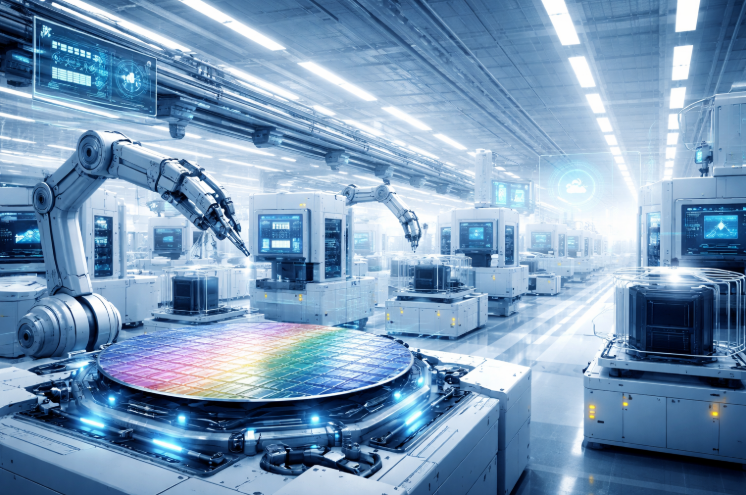
Semiconductor production involves highly complex and precise processes that require strict environmental control and exceptional accuracy. Even microscopic contamination or process variations can result in defective products and significant financial losses.
Several factors are driving the adoption of automation solutions in semiconductor facilities:
Increasing demand for advanced chips
Higher production volumes
Labor shortages in technical manufacturing sectors
Rising quality requirements
Greater process complexity
Need for real-time production monitoring
Continuous cost optimization
Automation technologies help manufacturers address these challenges while maintaining competitiveness in a rapidly evolving market.
Material handling is one of the most important applications of automation in semiconductor fabs.
Automated Material Handling Systems (AMHS) transport wafers, reticles, and production materials throughout the facility with minimal human interaction. These systems typically include:
Overhead Hoist Transport (OHT)
Automated Guided Vehicles (AGV)
Rail-guided transport systems
Robotic loading and unloading stations
Smart storage systems
By reducing manual handling, AMHS minimizes contamination risks and ensures consistent transportation of sensitive semiconductor products.
Automated logistics systems also improve production scheduling and reduce bottlenecks across manufacturing lines.
Robotic systems have become indispensable in semiconductor production environments.
Modern industrial robots perform highly repetitive tasks with exceptional precision, including:
Wafer transfer
Pick-and-place operations
Packaging processes
Inspection procedures
Die bonding
Component assembly
Robotic automation offers several advantages:
Improved accuracy
Reduced product damage
Consistent production quality
Higher throughput
Lower labor costs
Collaborative robots are increasingly being integrated into semiconductor facilities, enabling safe interaction between human operators and automated equipment.
Programmable Logic Controllers (PLCs) play a vital role in semiconductor manufacturing automation.
PLCs coordinate and monitor numerous production processes, including:
Chemical delivery systems
Vacuum control systems
Temperature regulation
Gas flow management
Equipment sequencing
Safety interlocks
Advanced PLC platforms provide reliable control in mission-critical manufacturing environments. Integrated communication networks allow seamless data exchange between production equipment and central control systems.
The use of PLC-based automation significantly improves process stability and reduces unplanned downtime.
Supervisory Control and Data Acquisition (SCADA) systems provide centralized visibility into semiconductor production operations.
SCADA platforms collect data from thousands of sensors and control devices throughout the facility. Operators can monitor:
Equipment status
Production performance
Environmental conditions
Energy consumption
Alarm events
Process parameters
Real-time dashboards allow management teams to identify operational issues quickly and make informed decisions.
Historical data collection also supports performance analysis and continuous improvement initiatives.
Quality control is a critical aspect of semiconductor manufacturing.
Machine vision systems use high-resolution cameras, artificial intelligence, and advanced image-processing algorithms to inspect products at various production stages.
Applications include:
Wafer surface inspection
Defect detection
Alignment verification
Package inspection
Marking verification
Dimensional measurement
Automated inspection systems can detect defects that may be difficult or impossible for human operators to identify.
The result is improved product quality, reduced scrap rates, and increased customer satisfaction.
The Industrial Internet of Things (IIoT) is revolutionizing semiconductor production facilities.
Smart sensors installed throughout manufacturing equipment continuously collect operational data such as:
Temperature
Pressure
Vibration
Humidity
Energy usage
Process performance metrics
IIoT platforms transmit this information to centralized analytics systems where it can be processed in real time.
Benefits include:
Enhanced visibility
Faster problem identification
Improved production efficiency
Better asset utilization
Reduced operational costs
Connected manufacturing environments create the foundation for smart factory initiatives.
Unexpected equipment failures can lead to costly production interruptions.
Predictive maintenance systems leverage automation, sensor technology, and artificial intelligence to monitor equipment health continuously.
By analyzing operational patterns, predictive maintenance platforms can identify early warning signs of:
Bearing wear
Motor degradation
Pump failures
Temperature abnormalities
Vibration issues
Maintenance teams receive alerts before equipment breakdowns occur, allowing repairs to be scheduled proactively.
This approach reduces downtime, extends equipment life, and lowers maintenance costs.
Semiconductor manufacturing requires extremely clean production environments.
Automated environmental monitoring systems continuously track:
Airborne particle levels
Temperature
Humidity
Air pressure
Chemical concentrations
Integrated automation systems can automatically adjust HVAC equipment and filtration systems to maintain strict cleanroom standards.
Real-time monitoring helps ensure compliance with industry requirements while protecting sensitive manufacturing processes.
Artificial Intelligence is becoming an increasingly important component of semiconductor automation strategies.
AI-powered systems support:
Process optimization
Yield improvement
Defect prediction
Production scheduling
Equipment diagnostics
Supply chain planning
Machine learning algorithms analyze vast amounts of production data to identify hidden patterns and recommend process improvements.
As AI technologies continue to evolve, semiconductor manufacturers will gain even greater opportunities to enhance efficiency and competitiveness.
The future of semiconductor manufacturing will be defined by higher levels of automation, intelligence, and connectivity.
Emerging technologies such as digital twins, edge computing, autonomous robotics, and advanced analytics will further transform production facilities. Manufacturers that invest in modern automation solutions will be better positioned to meet growing global demand while maintaining quality, efficiency, and profitability.
Automation has become a fundamental requirement for modern semiconductor production facilities. Through the integration of robotics, PLC control systems, SCADA platforms, machine vision, IIoT technologies, predictive maintenance solutions, and artificial intelligence, manufacturers can achieve unprecedented levels of productivity and quality.
As the semiconductor industry continues to expand, advanced automation solutions will play a central role in supporting innovation, operational excellence, and sustainable growth. Easy Semiconductor Technology (Hong Kong) Limited remains committed to supporting industrial customers with reliable automation technologies that drive manufacturing success in the semiconductor sector.