
 home
home
 Published: Jun 02, 2026 01:00 PM
 Page View: 111
The paper manufacturing industry is undergoing rapid transformation as global demand shifts toward higher efficiency, sustainability, and product consistency. Rising energy costs, stricter environmental regulations, and increasing customer expectations are driving manufacturers to adopt advanced automation solutions. Industrial automation is now a key enabler for modern paper mills, helping them optimize production, reduce waste, and improve operational reliability across all stages of the manufacturing process.
This article explores how automation technologies are reshaping the paper manufacturing industry and highlights key system components, applications, and benefits for industrial operators.
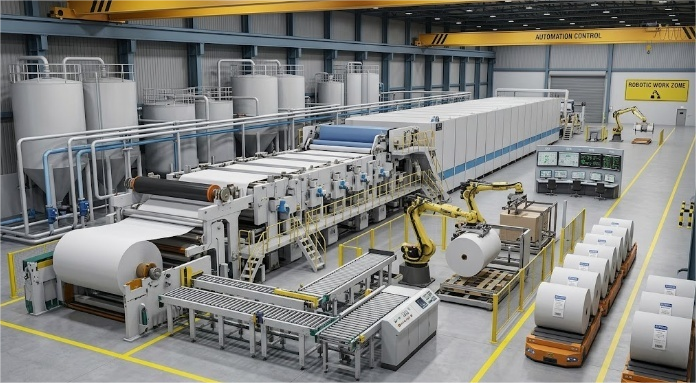
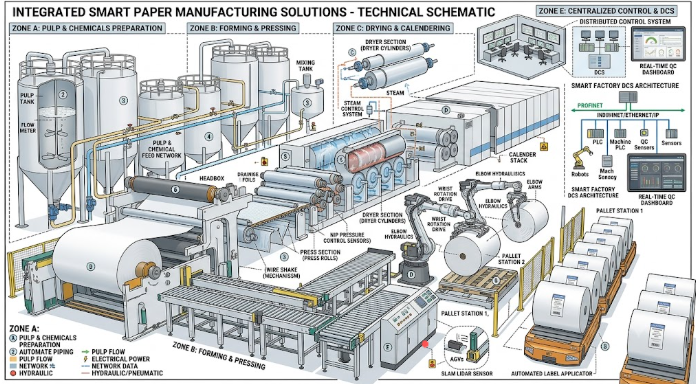
Paper production is a highly complex, continuous process involving raw material preparation, pulping, refining, sheet formation, pressing, drying, coating, and finishing. Each stage requires precise control of mechanical, chemical, and thermal parameters to ensure consistent quality.
Traditional manual control methods often struggle to maintain stability across long production cycles. Variations in moisture, fiber consistency, and machine speed can significantly impact final product quality. Automation systems address these challenges by providing real-time monitoring, closed-loop control, and data-driven optimization.
With the integration of Industry 4.0 technologies, paper mills are evolving into intelligent production environments where every machine, sensor, and control system is interconnected.
PLCs serve as the backbone of automation in paper manufacturing. They control critical equipment such as pulping systems, paper machines, conveyors, and rewinding units.
Modern PLC systems offer:
High-speed processing for continuous production lines
Modular architecture for scalable plant expansion
Reliable operation in harsh industrial environments
Seamless integration with SCADA and MES platforms
Advanced diagnostics for system health monitoring
By ensuring precise coordination between multiple production stages, PLCs significantly improve process stability and efficiency.
Supervisory Control and Data Acquisition (SCADA) systems provide centralized control and visualization of the entire paper production process. Human-Machine Interface (HMI) panels allow operators to interact with machines in real time.
Key advantages include:
Real-time process visualization
Alarm and fault detection
Historical data logging and analysis
Remote monitoring and control capabilities
Improved operator decision-making
These systems enhance transparency across production lines and reduce response time during operational issues.
Accurate measurement is essential in paper manufacturing. Smart sensors continuously monitor critical parameters such as:
Moisture content
Basis weight (grammage)
Temperature and humidity
Pressure and flow rates
Fiber consistency
These measurements are used to adjust machine settings automatically, ensuring consistent product quality and reducing material waste.
Reliable communication between devices is essential for coordinated production. Industrial networks connect PLCs, sensors, drives, and supervisory systems using protocols such as:
PROFINET
EtherNet/IP
Modbus TCP
OPC UA
These communication systems enable seamless data exchange and support real-time control strategies across the entire plant.
Automation systems control the pulping process by regulating chemical dosing, mixing intensity, and temperature. This ensures consistent fiber quality and reduces chemical consumption.
Benefits include:
Improved pulp uniformity
Reduced raw material waste
Optimized chemical usage
The paper machine is the most critical component of production. Automation ensures precise control of:
Machine speed
Drying temperature
Roll pressure
Moisture balance
Advanced closed-loop control systems continuously adjust parameters to maintain stable output quality.
Automated vision systems and sensors detect defects such as holes, uneven thickness, or surface irregularities. Real-time inspection ensures only high-quality products proceed to packaging.
This reduces:
Product recalls
Customer complaints
Material rework
Paper manufacturing is highly energy-intensive. Automation systems monitor and optimize energy consumption across drying units, motors, and heating systems.
Operators can:
Reduce peak energy demand
Improve energy efficiency
Lower operational costs
Support sustainability goals
Equipment failure in paper mills can cause costly downtime. Predictive maintenance systems analyze vibration, temperature, and performance data to detect early signs of wear.
This enables:
Scheduled maintenance before failure occurs
Reduced unplanned shutdowns
Extended equipment lifespan
Lower maintenance costs
Implementing automation solutions provides significant advantages:
Higher production efficiency and throughput
Improved product quality and consistency
Reduced material and energy waste
Enhanced operational safety
Lower labor dependency
Increased equipment reliability
Automation also enables better traceability and compliance with environmental and industrial standards.
The paper industry is increasingly adopting digital transformation technologies. Smart paper mills integrate:
Industrial Internet of Things (IIoT)
Cloud-based analytics
Artificial intelligence and machine learning
Digital twin simulation models
Remote monitoring platforms
These technologies allow manufacturers to optimize production in real time, forecast maintenance needs, and improve decision-making accuracy.
Several key trends are shaping the future of the industry:
Increased adoption of fully autonomous production lines
Greater use of AI-driven process optimization
Expansion of cloud-connected monitoring systems
Enhanced cybersecurity for industrial networks
Development of sustainable and energy-efficient production systems
Manufacturers that invest in automation today will be better positioned to compete in a rapidly evolving global market.
Automation is revolutionizing the paper manufacturing industry by improving efficiency, enhancing product quality, reducing operational costs, and supporting sustainability goals. Through the integration of PLCs, SCADA systems, intelligent sensors, and advanced analytics, paper mills can achieve higher levels of performance and reliability.
As digital transformation continues, automation will remain a critical driver of innovation in paper production, enabling factories to evolve into smart, connected, and highly efficient manufacturing systems.
Easy Semiconductor Technology (Hong Kong) Limited is a professional provider of industrial automation solutions, specializing in PLC systems, control technologies, and industrial electronics. The company is committed to delivering reliable, innovative, and cost-effective solutions that help manufacturing industries improve productivity, efficiency, and long-term sustainability.