
 home
home
 Published: Jun 01, 2026 09:53 PM
 Page View: 147
Variable Frequency Drives (VFDs) have become essential components in modern industrial automation systems. They are widely used to control motor speed, improve energy efficiency, reduce mechanical stress, and optimize production processes. From manufacturing plants and water treatment facilities to HVAC systems and conveyor applications, VFDs play a critical role in ensuring reliable operations.
However, like any industrial electronic equipment, VFDs can experience failures that disrupt production and increase maintenance costs. Understanding common VFD faults and their troubleshooting methods can help maintenance engineers minimize downtime and improve system reliability.
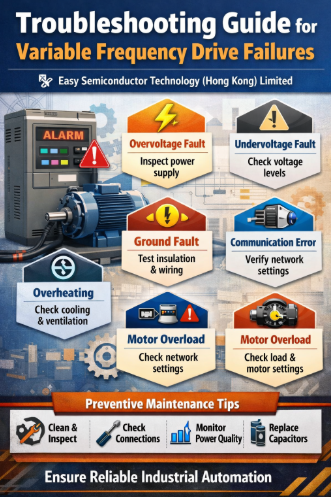
A VFD regulates the frequency and voltage supplied to an electric motor, allowing precise speed control. Because VFDs operate continuously in demanding industrial environments, they are exposed to heat, dust, electrical noise, voltage fluctuations, and mechanical vibration.
When a VFD fails, the consequences may include production stoppages, equipment damage, reduced product quality, and increased operational expenses. Therefore, identifying the root cause of failures quickly is essential for maintaining efficient industrial operations.
Overheating is one of the most frequently encountered VFD issues. Excessive temperatures can damage internal components such as power modules, capacitors, and control boards.
Blocked ventilation openings
Failed cooling fans
High ambient temperatures
Excessive motor loading
Dust accumulation inside the drive
Inspect cooling fans and replace faulty units.
Clean air filters and ventilation pathways.
Verify ambient temperature complies with manufacturer specifications.
Check motor current and load conditions.
Ensure adequate clearance around the drive cabinet.
Implementing regular cleaning schedules can significantly reduce overheating-related failures.
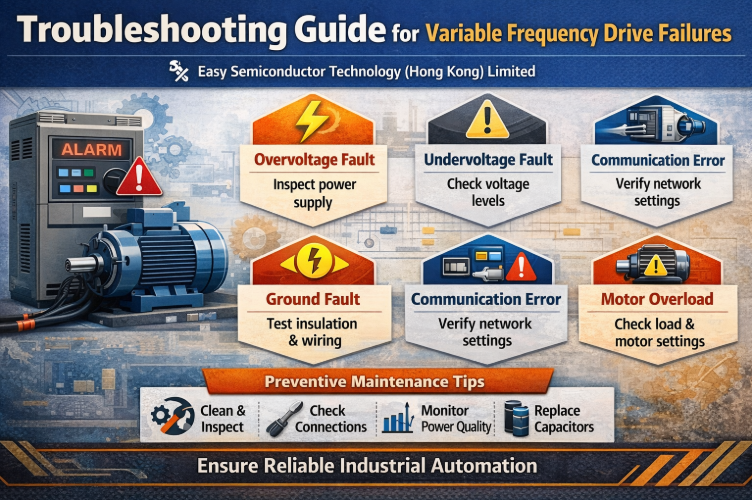
VFD overvoltage alarms typically occur when the DC bus voltage exceeds safe operating limits.
Regenerative energy from rapid motor deceleration
Unstable power supply
Incorrect braking resistor configuration
Utility voltage spikes
Measure incoming supply voltage.
Extend motor deceleration time.
Inspect braking resistor connections.
Verify drive parameter settings.
Install surge protection devices if necessary.
Proper power quality management can help prevent repeated overvoltage conditions.
Undervoltage conditions occur when the incoming power supply falls below acceptable levels.
Utility power disturbances
Loose electrical connections
Undersized power cables
Transformer issues
Measure line voltage during operation.
Inspect terminals and tighten loose connections.
Verify cable sizing and installation quality.
Check upstream electrical equipment.
Consistent monitoring of power quality is essential for preventing undervoltage-related shutdowns.
Ground faults are serious issues that may indicate insulation failure or wiring damage.
Damaged motor cables
Moisture ingress
Motor winding insulation breakdown
Improper grounding practices
Perform insulation resistance testing.
Inspect motor cables for physical damage.
Check grounding continuity.
Examine motor condition using a megohmmeter.
Immediate investigation is recommended whenever ground fault alarms occur to prevent equipment damage and safety hazards.
Many modern VFDs communicate with PLCs, SCADA systems, and industrial networks through protocols such as Modbus, Profibus, Ethernet/IP, or Profinet.
Network cable damage
Incorrect communication settings
Electromagnetic interference (EMI)
PLC configuration errors
Verify network wiring integrity.
Confirm baud rate and communication parameters.
Check device addressing.
Inspect shielding and grounding practices.
Review PLC and network configurations.
Reliable communication is essential for advanced automation and remote monitoring applications.
Motor overload protection is designed to prevent overheating and mechanical damage.
Excessive mechanical load
Incorrect motor parameters
Bearing failures
Process-related issues
Compare actual motor current with rated current.
Inspect mechanical equipment for binding.
Verify motor nameplate settings in the VFD.
Check bearings, couplings, and driven equipment.
Addressing overload conditions promptly helps extend motor life and reduce maintenance costs.
Electrolytic capacitors are among the most vulnerable components within a VFD. Over time, their performance degrades due to thermal stress and aging.
Frequent fault codes
Increased ripple voltage
Reduced drive performance
Physical swelling or leakage
Conduct periodic inspections.
Replace aging capacitors during scheduled maintenance.
Monitor operating temperatures.
Follow manufacturer replacement intervals.
Preventive replacement can avoid unexpected breakdowns and costly production interruptions.
The most effective way to reduce VFD failures is through proactive maintenance.
Recommended practices include:
Regular cleaning of cooling systems
Thermal inspections using infrared cameras
Periodic tightening of electrical connections
Power quality monitoring
Firmware updates when applicable
Routine inspection of fans and capacitors
Scheduled motor insulation testing
Establishing a preventive maintenance program helps identify potential issues before they become critical failures.
Variable Frequency Drives are vital assets in modern industrial facilities, providing energy savings, process optimization, and precise motor control. While VFD failures can occur due to electrical, environmental, or mechanical factors, most issues can be resolved through systematic troubleshooting and preventive maintenance.
By understanding common failure modes such as overheating, voltage faults, communication errors, ground faults, and component aging, maintenance teams can significantly reduce downtime and improve equipment reliability. Investing in regular inspections, proper installation practices, and predictive maintenance strategies will ensure long-term VFD performance and support continuous industrial production.
As industrial automation continues to evolve, reliable VFD operation remains a key factor in achieving operational excellence and maximizing return on investment.
About Easy Semiconductor Technology (Hong Kong) Limited
Easy Semiconductor Technology (Hong Kong) Limited specializes in supplying industrial automation components, electronic parts, PLC systems, drives, sensors, and control solutions for global manufacturing industries. The company is committed to providing reliable products, technical expertise, and efficient supply chain support to help customers achieve higher productivity and operational efficiency.