
 home
home
 Published: May 27, 2026 09:22 AM
 Page View: 111
Global industrial trade continues facing significant challenges due to ongoing component shortages across semiconductor devices, automation systems, electronic modules, and industrial control equipment. From manufacturing plants to logistics providers, businesses worldwide are experiencing delays, rising procurement costs, and production uncertainty. As international markets become increasingly interconnected, component shortages have evolved from temporary disruptions into long-term operational risks.
For exporters, distributors, and industrial solution providers, overcoming these shortages requires more than short-term purchasing tactics. Companies must develop resilient procurement systems, diversify supply chains, strengthen supplier relationships, and embrace digital technologies to maintain competitiveness in global trade.
Component shortages are driven by multiple global factors. Semiconductor demand continues rising due to growth in automation, electric vehicles, renewable energy systems, AI infrastructure, and smart manufacturing technologies. At the same time, geopolitical tensions, trade restrictions, transportation bottlenecks, and raw material limitations have disrupted production capacities worldwide.
Industrial sectors particularly affected include:
Semiconductor manufacturing equipment
PLC and DCS automation systems
Industrial sensors and controllers
Power management devices
Communication modules
Obsolete electronic components
Many manufacturers also rely heavily on specialized suppliers located in limited geographic regions. When disruptions occur in one area, the impact spreads rapidly throughout the international supply chain.
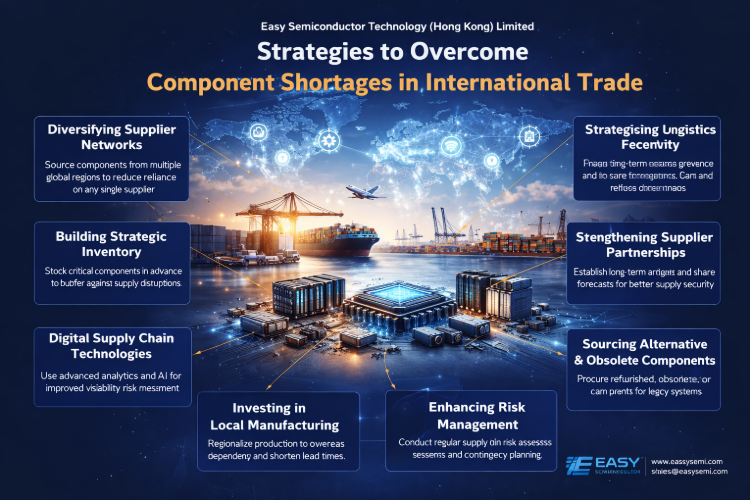
One of the most effective strategies for overcoming shortages is supplier diversification. Companies that depend on a single source or single-country procurement model face significantly higher risks during supply disruptions.
Successful exporters now establish multi-region sourcing strategies that include suppliers from:
East Asia
Southeast Asia
Europe
North America
Emerging industrial markets
Diversification improves procurement flexibility and reduces dependency on any one supplier or transportation route. Businesses can also reduce lead time volatility by maintaining backup suppliers for critical components.
Supplier diversification does not simply mean adding more vendors. Companies must carefully evaluate supplier reliability, technical certifications, production capabilities, quality standards, and long-term financial stability.
Traditional “just-in-time” inventory systems have proven vulnerable during global shortages. Many industrial companies are now transitioning toward hybrid inventory models that combine lean operations with strategic safety stock reserves.
Critical components such as semiconductors, PLC modules, industrial sensors, and communication boards are increasingly being stocked in advance to avoid production interruptions.
Strategic inventory planning helps companies:
Reduce emergency procurement costs
Maintain customer delivery schedules
Improve production continuity
Minimize downtime risks
Increase export reliability
Data-driven forecasting tools also help businesses identify which components require higher reserve levels based on demand volatility and supplier lead times.
Strong supplier relationships have become a competitive advantage in international trade. During shortages, manufacturers often prioritize long-term strategic customers over occasional buyers.
Companies can improve supply security by:
Establishing long-term procurement agreements
Sharing demand forecasts with suppliers
Creating collaborative planning systems
Maintaining transparent communication
Supporting joint inventory management initiatives
Partnership-based procurement improves trust and increases the likelihood of receiving priority allocations during periods of constrained supply.
Industrial exporters that maintain stable supplier partnerships are often better positioned to secure high-demand components even during market disruptions.
Digital transformation plays an increasingly important role in shortage management. Advanced analytics, AI-powered forecasting systems, and real-time inventory monitoring enable businesses to respond more quickly to supply chain disruptions.
Modern supply chain platforms provide visibility across:
Supplier production status
Global shipment tracking
Warehouse inventory levels
Demand forecasting trends
Procurement risk analysis
Automation technologies also improve procurement efficiency by reducing manual errors and accelerating purchasing decisions.
Some companies now integrate predictive analytics into procurement systems to identify potential shortages months before they impact production schedules.
In many industrial sectors, sourcing discontinued or obsolete components has become essential for maintaining legacy equipment operations. Older PLC systems, industrial computers, and automation controllers often remain critical to factory infrastructure despite no longer being in active production.
Companies increasingly work with specialized suppliers capable of sourcing:
Refurbished industrial modules
Certified obsolete components
Compatible replacement parts
Legacy automation systems
This approach helps manufacturers avoid costly full-system upgrades while extending the operational lifespan of existing industrial equipment.
Easy Semiconductor Technology (Hong Kong) Limited continues supporting international customers by helping identify reliable solutions for hard-to-find industrial and semiconductor components.
Transportation disruptions remain a major contributor to supply shortages. Rising shipping costs, port congestion, customs delays, and limited air cargo capacity have affected delivery schedules worldwide.
To improve resilience, many exporters are implementing flexible logistics strategies that include:
Multi-route shipping networks
Regional warehouse distribution
Alternative freight providers
Localized inventory hubs
Mixed transportation methods
Flexible logistics planning reduces dependency on a single transportation channel and improves response speed during emergencies.
Regional warehousing also enables faster fulfillment for international customers while lowering the risks associated with long-distance shipping delays.
Some international companies are partially reshoring or regionalizing production operations to reduce overseas dependency. Localized manufacturing improves supply stability and shortens transportation lead times.
Although complete supply chain localization may not always be practical, regional production partnerships can help companies:
Improve delivery responsiveness
Reduce geopolitical risks
Lower transportation exposure
Enhance supply predictability
This trend is becoming increasingly important in industries where component availability directly impacts production continuity.
Modern international trade requires proactive risk management rather than reactive crisis response. Businesses now conduct regular supply chain risk assessments to identify vulnerabilities before disruptions occur.
Key risk management practices include:
Monitoring geopolitical developments
Evaluating supplier concentration risks
Tracking raw material availability
Conducting contingency planning
Maintaining emergency procurement procedures
Scenario planning also allows organizations to prepare alternative sourcing strategies for various market conditions.
Companies with strong risk management systems are generally more adaptable during periods of uncertainty and market instability.
Although global supply conditions are gradually improving in some sectors, component shortages are expected to remain a recurring challenge in international trade over the next several years. Rapid industrial digitalization, increasing semiconductor demand, and evolving global trade policies will continue shaping procurement strategies worldwide.
Businesses that invest in diversified sourcing, digital supply chain management, strategic inventory planning, and collaborative supplier partnerships will be better positioned for long-term success.
For industrial exporters and technology providers, resilience is no longer optional. It has become a core competitive advantage in the modern global marketplace.
Easy Semiconductor Technology (Hong Kong) Limited remains committed to supporting global customers with reliable industrial component sourcing solutions, helping businesses maintain operational stability and international competitiveness despite ongoing supply chain challenges.