
 home
home
 Published: May 26, 2026 01:07 PM
 Page View: 171
In today’s highly competitive industrial landscape, smart manufacturing has become a key factor influencing global purchasing decisions. Buyers across industries are no longer focused solely on product price and production capacity. Instead, they increasingly prioritize efficiency, automation, quality control, sustainability, and supply chain reliability. Companies that embrace smart manufacturing solutions are gaining a significant advantage in international markets by delivering higher productivity, faster response times, and improved operational transparency.
According to industry analysts, global demand for intelligent manufacturing technologies continues to rise as manufacturers seek greater resilience and digital transformation. For exporters and industrial suppliers, smart manufacturing is no longer optional — it has become a strategic necessity for attracting and retaining international customers.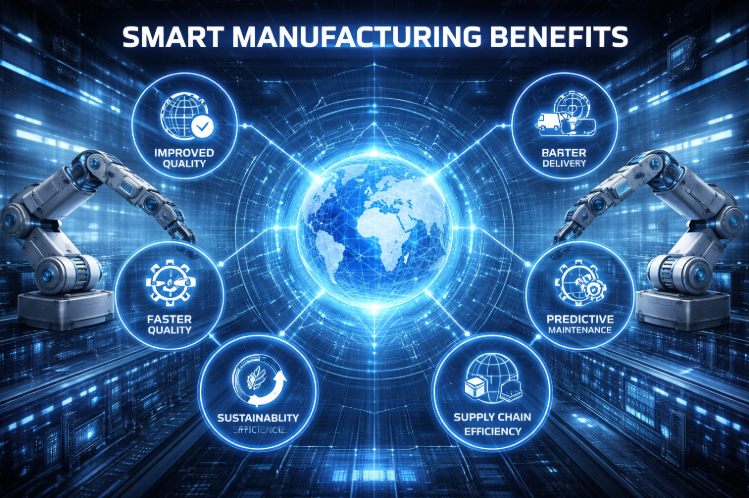
Smart manufacturing combines advanced automation, Industrial Internet of Things (IIoT), artificial intelligence (AI), robotics, cloud computing, and real-time data analytics to optimize production processes. These technologies enable factories to operate with greater efficiency, flexibility, and accuracy.
Global buyers prefer suppliers with smart manufacturing capabilities because they can offer:
Faster production cycles
Consistent product quality
Reduced operational risks
Better traceability
Lower downtime
Improved inventory management
Enhanced customization capabilities
As global supply chains become increasingly complex, buyers are looking for partners who can adapt quickly to changing market demands. Smart factories provide this flexibility through data-driven decision-making and automated production systems.
One of the biggest advantages of smart manufacturing is its ability to improve product quality. Automated inspection systems, AI-powered defect detection, and real-time monitoring significantly reduce human error during production.
International buyers, especially in industries such as semiconductor manufacturing, industrial automation, aerospace, and automotive electronics, require strict quality standards. Smart manufacturing systems ensure higher consistency across production batches, which strengthens supplier credibility.
For example, predictive analytics can identify equipment abnormalities before failures occur. This minimizes production defects and prevents costly shipment delays. Buyers value suppliers that can maintain stable product performance while reducing quality-related risks.
Advanced traceability systems also allow manufacturers to track every stage of production. This transparency gives global customers greater confidence in product reliability and compliance.
Global buyers increasingly prioritize reliable delivery schedules. Delays in industrial equipment or semiconductor components can disrupt entire manufacturing operations.
Smart manufacturing solutions help companies improve delivery performance through automated scheduling, intelligent inventory systems, and predictive maintenance technologies. These systems reduce unplanned downtime and optimize factory workflows.
Real-time production visibility also enables suppliers to communicate more accurately with customers regarding lead times and order status. Buyers appreciate transparent communication and dependable logistics coordination.
In recent years, supply chain disruptions have exposed the importance of operational flexibility. Manufacturers using smart technologies can adapt more effectively to sudden material shortages, transportation issues, or market fluctuations.
This responsiveness makes suppliers more attractive to international procurement teams seeking long-term partnerships.
Data has become one of the most valuable assets in modern manufacturing. Smart factories generate large volumes of operational data that can be analyzed to improve decision-making and customer service.
Global buyers increasingly expect suppliers to provide production visibility, quality reports, and performance metrics. Smart manufacturing systems make this possible through cloud-based platforms and digital dashboards.
Real-time reporting allows customers to monitor:
Production progress
Equipment performance
Product testing results
Inventory availability
Shipment tracking
Quality assurance data
This level of transparency strengthens trust between suppliers and international buyers. It also helps reduce misunderstandings and improves overall business efficiency.
For multinational corporations, data transparency is particularly important when evaluating long-term manufacturing partners.
Sustainability has become a major purchasing factor in global industrial markets. Many international companies now require suppliers to demonstrate environmentally responsible manufacturing practices.
Smart manufacturing supports sustainability through:
Energy-efficient automation
Reduced material waste
Optimized resource consumption
Predictive maintenance
Lower emissions
Intelligent energy monitoring
Automated systems can identify inefficiencies and reduce unnecessary energy usage. This lowers production costs while helping companies meet international environmental standards.
Buyers in Europe, North America, and Asia increasingly prefer suppliers that align with ESG (Environmental, Social, and Governance) objectives. Manufacturers adopting green technologies can strengthen their global competitiveness and access new export opportunities.
Today’s buyers often require customized industrial solutions tailored to specific applications. Traditional manufacturing systems may struggle to handle frequent product variations efficiently.
Smart manufacturing technologies improve production flexibility through programmable automation and intelligent production management systems. Manufacturers can quickly adjust production parameters, accommodate small batch orders, and respond to changing customer requirements.
This flexibility is particularly important in industries such as:
Semiconductor equipment
Industrial automation
Robotics
Medical devices
Renewable energy systems
Suppliers capable of delivering customized solutions with short lead times are more likely to secure long-term international contracts.
Downtime remains one of the biggest concerns for global buyers. Unexpected equipment failures can cause major financial losses and supply chain disruptions.
Smart manufacturing systems use predictive maintenance technologies to monitor machine conditions continuously. Sensors collect real-time data on vibration, temperature, pressure, and equipment performance.
AI-powered analytics can detect early signs of mechanical problems before failures occur. Maintenance teams can then address issues proactively instead of waiting for breakdowns.
For global buyers, this means:
Higher production reliability
More stable supply chains
Fewer shipment delays
Lower operational risks
Manufacturers with strong maintenance capabilities are often viewed as more dependable partners in international markets.
As industries worldwide continue accelerating digital transformation, buyers are actively searching for technologically advanced suppliers.
Smart manufacturing demonstrates a company’s commitment to innovation, operational excellence, and long-term competitiveness. Exporters that invest in automation and digital systems are often perceived as more capable of supporting future market demands.
In addition, digitalized factories can scale production more efficiently while maintaining consistent quality standards. This scalability is highly attractive to multinational buyers managing global procurement operations.
Companies that delay digital transformation may struggle to compete against technologically advanced manufacturers offering faster service, better quality control, and improved operational transparency.
Smart manufacturing is rapidly reshaping the future of industrial production and international trade. As automation, AI, and IIoT technologies continue evolving, buyers will increasingly favor suppliers capable of delivering intelligent, data-driven manufacturing solutions.
For industrial exporters, smart manufacturing is not simply a technology upgrade — it is a business strategy that directly influences customer trust, operational efficiency, and global market expansion.
Manufacturers that embrace digital transformation can strengthen their position in competitive export markets while building stronger long-term relationships with international buyers.
In the years ahead, smart manufacturing solutions will continue driving industrial innovation, helping companies improve productivity, reduce costs, enhance sustainability, and meet the growing expectations of global customers.