
 home
home
 Published: May 09, 2026 01:29 PM
 Page View: 103
Programmable Logic Controllers (PLCs) are the core of industrial automation systems, serving as the "brain" that controls production processes, coordinates equipment operations, and ensures the stability of industrial plants. However, many industrial plants around the world are plagued by frequent PLC faults, which lead to unplanned downtime, reduced production efficiency, and significant economic losses. Understanding the root causes of these frequent faults is crucial for improving production stability and reducing operational risks. Based on years of industry experience and on-site practice, Easy Semiconductor summarizes the key reasons why industrial plants experience frequent PLC faults, providing targeted insights to help enterprises address these issues effectively. Easy Semiconductor provides a professional quick repair solution for turbine monitoring systems, covering fault positioning, repair and optimization to reduce losses.
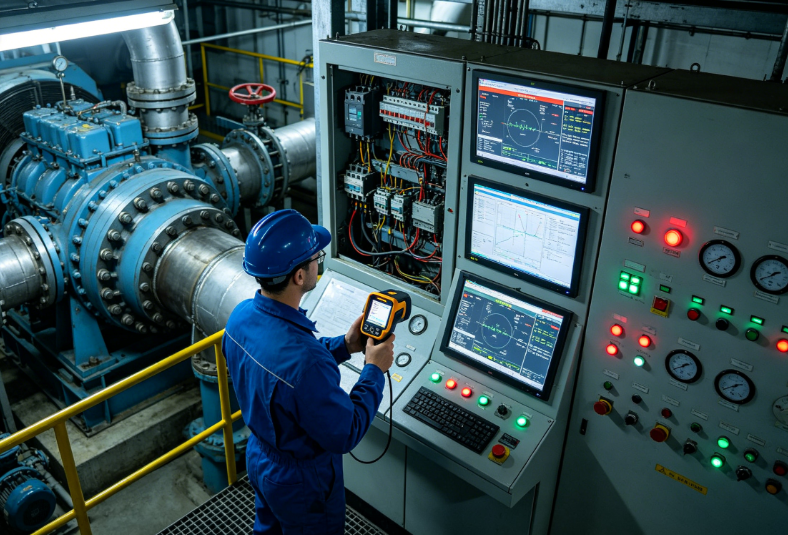
The most common cause of frequent PLC faults is power supply instability, accounting for approximately 30% of all PLC failure cases. Industrial plants often have complex power supply environments, and voltage fluctuations, power surges, or unstable grounding can easily damage the PLC’s power module. For example, sudden voltage spikes caused by equipment startup or grid fluctuations can burn out the PLC’s internal power components, while poor grounding can lead to electromagnetic interference, resulting in program errors or component damage. Many plants ignore the importance of power supply protection, failing to install surge protectors or UPS systems, which makes PLCs vulnerable to power-related failures. In addition, expired or faulty backup batteries in PLCs can cause program loss or clock errors, further increasing the risk of faults.
Environmental factors are another major contributor to frequent PLC faults. Industrial plants, especially those in chemical, oil and gas, and heavy manufacturing sectors, often have harsh operating environments—high temperature, high humidity, and large amounts of dust and corrosive gases can accelerate the aging of PLC components. Dust accumulation on the PLC’s heat sink and internal components blocks heat dissipation, leading to overheating and component failure. Corrosive gases and moisture can corrode the PLC’s circuit board and terminals, resulting in poor contact or short circuits. Moreover, direct sunlight exposure or improper installation locations (such as near high-temperature equipment) can further damage the PLC’s internal structure, reducing its service life and increasing failure frequency.
Improper operation and inadequate maintenance also play a key role in frequent PLC faults. Many plant operators lack standardized operational training, leading to incorrect parameter settings, wrong wiring, or accidental modification of control programs—all of which can cause PLC malfunctions. For example, incorrect wiring of sensors or confusion between NPN and PNP signal types can lead to input/output signal errors, while unauthorized program modifications can cause logic conflicts or dead loops, resulting in PLC crashes. Additionally, many plants adopt a "repair-after-failure" approach instead of proactive maintenance, failing to regularly inspect and calibrate PLCs, which allows hidden faults to accumulate and eventually lead to serious failures.
Software and communication issues are also important factors affecting PLC stability. Outdated firmware or untested software updates can introduce bugs, leading to program crashes or communication failures. Meanwhile, with the integration of industrial IoT, PLCs are increasingly connected to networks, making them vulnerable to cyber threats such as malware attacks, which can tamper with control logic or damage software systems. Communication failures, such as loose wiring, damaged cables, or mismatched communication protocols, can also cause the PLC to lose connection with other devices, resulting in operational errors.
Furthermore, the use of low-quality components or incompatible spare parts exacerbates PLC failure rates. Some plants choose cheap, non-industrial-grade components to cut costs, but these components often have poor stability and short service lives, leading to frequent replacements and faults. Incompatible firmware versions or incorrect module configurations can also cause system conflicts, making the PLC unable to operate normally and increasing failure frequency.
Frequent PLC faults not only disrupt production schedules but also increase maintenance costs and safety risks. As a professional industrial automation solution provider, Easy Semiconductor Technology (Hong Kong) Limited has rich experience in solving PLC fault problems. We provide high-quality PLC components with high stability and long service life, and offer professional technical guidance on power supply optimization, environmental control, and operational standardization to help plants reduce PLC failure rates. Our professional technical team can quickly locate fault points, provide efficient repair solutions, and assist enterprises in establishing proactive maintenance systems to avoid unplanned downtime.
In conclusion, frequent PLC faults in industrial plants are the result of multiple factors, including power supply instability, harsh environmental conditions, improper operation and maintenance, software and communication issues, and the use of low-quality components. By addressing these root causes—such as optimizing power supply protection, improving operating environments, standardizing operations, and using high-quality components—enterprises can significantly reduce PLC failure frequency, ensure stable production, and achieve cost savings and efficiency improvements. Easy Semiconductor is committed to providing comprehensive support for industrial plants, helping them solve PLC fault problems and promote sustainable and stable production.