
 home
home
 Published: May 08, 2026 12:19 PM
 Page View: 115
In the era of industrial automation, Programmable Logic Controller (PLC) modules serve as the core control components of intelligent production lines, manufacturing equipment, energy systems and automated logistics facilities. The stable operation of PLC modules directly determines production efficiency, operational safety and enterprise economic benefits. However, in actual industrial operation scenarios, PLC modules often suffer from abnormal failures due to harsh operating environments, irregular power supply, improper installation and daily maintenance negligence, resulting in equipment shutdown, production suspension and even safety accidents. Easy Semiconductor Technology (Hong Kong) Limited, as a professional supplier and technical service provider of industrial control semiconductor and PLC spare parts, summarizes the common failure causes of PLC modules in the industry and puts forward targeted practical solutions based on years of on-site service experience and industrial control project practice, helping enterprises reduce failure rates and extend the service life of PLC equipment.
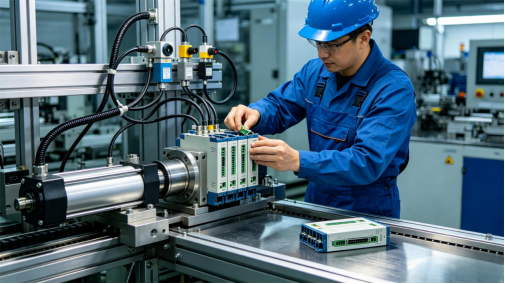
Unstable power supply is the primary cause of PLC module failure, accounting for nearly 40% of all industrial PLC faults. Common power supply abnormalities include instantaneous voltage surge, long-term low voltage, frequent power on and off, and ungrounded power loops. Long-term voltage fluctuation will accelerate the aging of internal filter capacitors and circuit chips of PLC power modules, resulting in failure to start, automatic restart and program loss. Severe surge impact will directly burn out the power supply unit and CPU module. In addition, aging backup batteries of PLC will cause data and program loss after power failure, leading to system operation disorder. To solve this problem, enterprises should install regulated power supplies and UPS uninterruptible power supply systems for PLC control cabinets to avoid voltage impact; regularly replace PLC backup batteries in accordance with the equipment manual; standardize power wiring, ensure reliable grounding of power lines, and isolate industrial high-power equipment from PLC power supply loops to prevent current interference.
Harsh environmental factors are another major inducement of PLC module damage. Industrial sites often face high temperature, high humidity, dust accumulation, chemical corrosion and strong electromagnetic interference. Long-term high temperature operation will cause CPU and I/O modules to overheat, reduce computing performance and trigger automatic protection shutdown; humid and dusty environments will lead to poor contact of module terminals, circuit board short circuit and metal connector oxidation; corrosive gas in chemical and pharmaceutical workshops will erode the internal circuit of PLC. Strong electromagnetic interference generated by frequency converters, motors and high-voltage cables will disrupt PLC signal transmission, cause I/O signal distortion and communication failure. The effective solutions include installing industrial air conditioners and heat dissipation fans in control cabinets to maintain constant temperature and humidity; regularly cleaning dust on PLC modules and wiring terminals; using sealed control cabinets for corrosive working conditions and adopting shielded cables for signal wiring; keeping PLC installation positions away from high-power electromagnetic equipment, and doing a good job in overall system shielding and grounding.
I/O module failure and communication fault are frequent abnormal phenomena in daily operation. I/O module faults are mostly manifested as input and output channel burnout, signal no response and intermittent signal jump, which are usually caused by external circuit short circuit, load overload and wrong wiring. Communication failures often occur in the connection between PLC and HMI, frequency converter and remote I/O modules, caused by incorrect communication protocol configuration, mismatched baud rate, damaged network cables and IP address conflicts. For I/O module faults, maintenance personnel should use a multimeter to check circuit continuity and load capacity, replace burned-out modules in time, and standardize on-site wiring to avoid overloading the output loop. For communication faults, it is necessary to check network cable integrity and terminal resistance, unify communication parameter settings, eliminate IP address conflicts, and regularly upgrade module firmware to optimize communication stability.
Improper manual operation and lack of daily maintenance will also accelerate PLC module aging and failure. Unplugging and plugging modules with power on, random modification of program parameters, and incorrect module installation will easily damage internal hardware and system programs. Many enterprises lack regular maintenance plans, resulting in hidden dangers not eliminated in time. Easy Semiconductor Technology (Hong Kong) Limited recommends that enterprises formulate a standardized daily maintenance system: prohibit hot plugging of PLC modules, train operation and maintenance personnel on professional skills, regularly back up PLC programs and parameter data, and establish equipment maintenance files to realize early detection and early handling of potential faults.
In conclusion, PLC module failure is mainly caused by power supply, environment, hardware communication and human operation. Adopting standardized installation, stable power allocation, environmental protection and regular professional maintenance can effectively reduce failure probability. Easy Semiconductor Technology (Hong Kong) Limited will continue to focus on industrial control semiconductor and PLC supporting services, provide enterprises with original PLC modules, technical troubleshooting, maintenance consulting and one-stop supporting solutions, and help the industrial automation industry operate efficiently and stably.