
 home
home
 Published: Apr 24, 2026 10:27 PM
 Page View: 112
Published by Easy Semiconductor Technology (Hong Kong) Limited
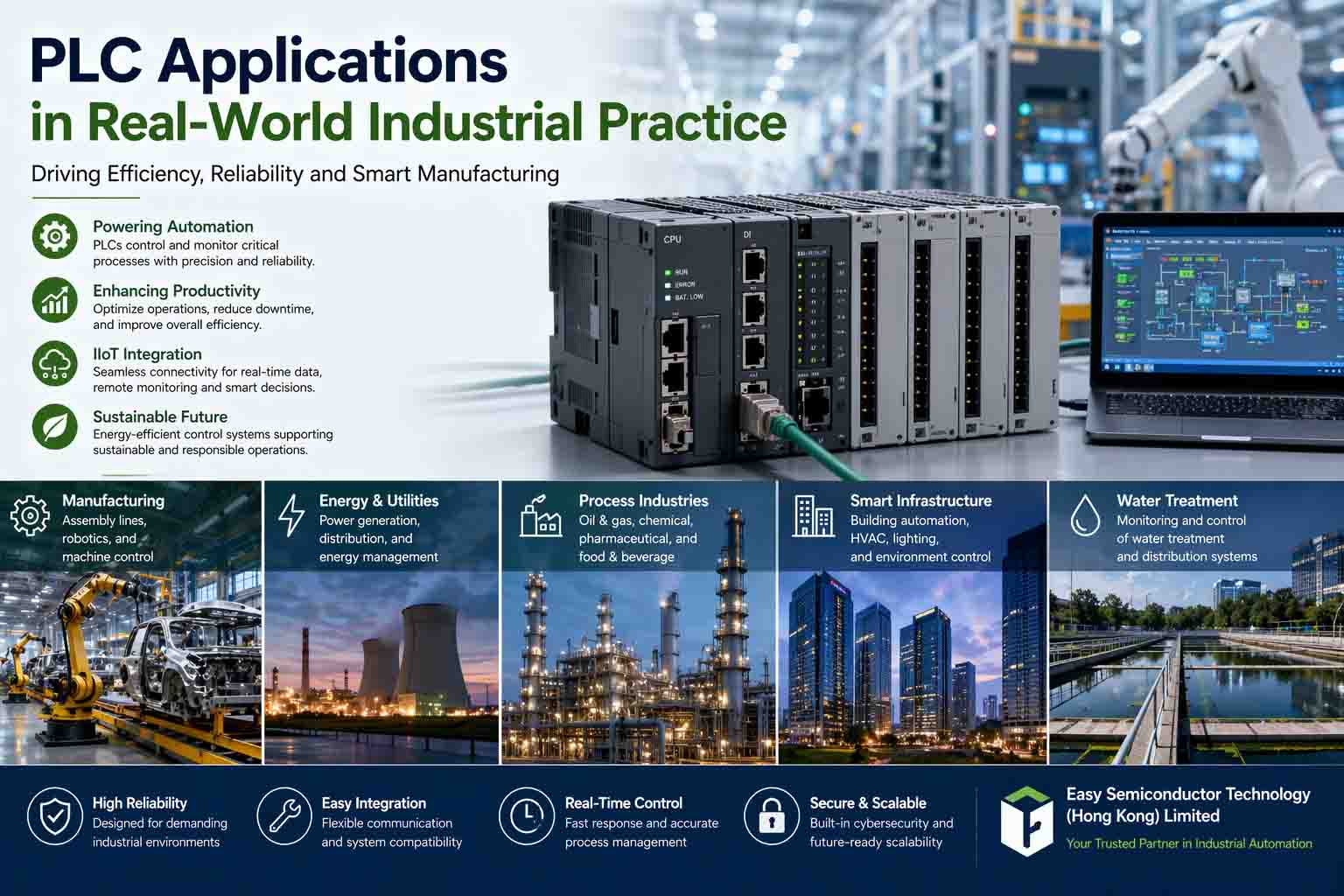
In the evolving landscape of industrial automation, the Programmable Logic Controller (PLC) remains a foundational technology powering modern manufacturing, energy systems, and process industries. As Industry 4.0 accelerates digital transformation, PLC applications are expanding beyond basic control logic into advanced, interconnected, and intelligent operational environments.
PLCs are industrial-grade digital controllers designed to automate electromechanical processes. In practical applications, PLCs are widely used to control:
Assembly lines and robotic systems
Packaging and material handling equipment
Water treatment and energy distribution systems
HVAC and building automation
Their robustness, real-time processing capability, and high reliability make PLCs essential for mission-critical operations.
Manufacturing Automation:
In automotive and electronics production, PLCs coordinate robotic arms, conveyor systems, and quality inspection units. By integrating sensors and actuators, PLC-based systems ensure precise timing, repeatability, and reduced human error.
Energy and Utilities:
PLCs are deployed in power plants and substations for monitoring and controlling turbines, generators, and grid distribution. Their ability to operate in harsh environments ensures stable energy supply and system safety.
Process Industries:
In oil & gas, chemical processing, and food production, PLCs manage continuous processes such as flow control, temperature regulation, and pressure monitoring. This enables consistent product quality and regulatory compliance.
Smart Infrastructure:
PLCs are increasingly integrated into smart buildings and infrastructure systems, managing lighting, elevators, and environmental controls with improved energy efficiency.
Modern PLC systems are no longer isolated controllers. With the rise of the Industrial Internet of Things (IIoT), PLCs now:
Connect to cloud platforms for data analytics
Enable predictive maintenance through real-time monitoring
Integrate with SCADA and MES systems
Support remote diagnostics and control
This convergence transforms PLCs into intelligent edge devices, bridging operational technology (OT) and information technology (IT).
Implementing PLC-based automation delivers measurable business benefits:
Reduced downtime through automated fault detection
Improved productivity via optimized process control
Lower labor costs by minimizing manual intervention
Energy efficiency through precise system management
In practice, companies adopting PLC solutions report significant improvements in overall equipment effectiveness (OEE) and return on investment (ROI).
Sustainability is becoming a priority in industrial operations. PLC systems contribute by:
Extending equipment lifespan through controlled operation
Supporting predictive maintenance strategies
Reducing waste and energy consumption
Additionally, the reuse and refurbishment of PLC modules align with circular economy practices, enabling companies to maintain legacy systems while minimizing environmental impact.
Despite their advantages, PLC implementation faces challenges such as:
Integration with legacy systems
Cybersecurity risks in connected environments
Skills gap in advanced automation technologies
Looking forward, PLCs will continue evolving with:
AI-driven control logic
Edge computing capabilities
Enhanced cybersecurity frameworks
Greater interoperability across platforms
The application of PLCs in real-world industrial practice is expanding rapidly, driven by the need for efficiency, reliability, and digital transformation. As industries move toward smart manufacturing, PLCs remain at the core of automation strategies—enabling seamless control, data integration, and intelligent decision-making.
Easy Semiconductor Technology (Hong Kong) Limited continues to support global industries with high-quality PLC solutions, refurbished modules, and automation expertise, helping businesses achieve sustainable growth and operational excellence.