
 home
home
 Published: Apr 24, 2026 10:24 PM
 Page View: 109
Published by Easy Semiconductor Technology (Hong Kong) Limited
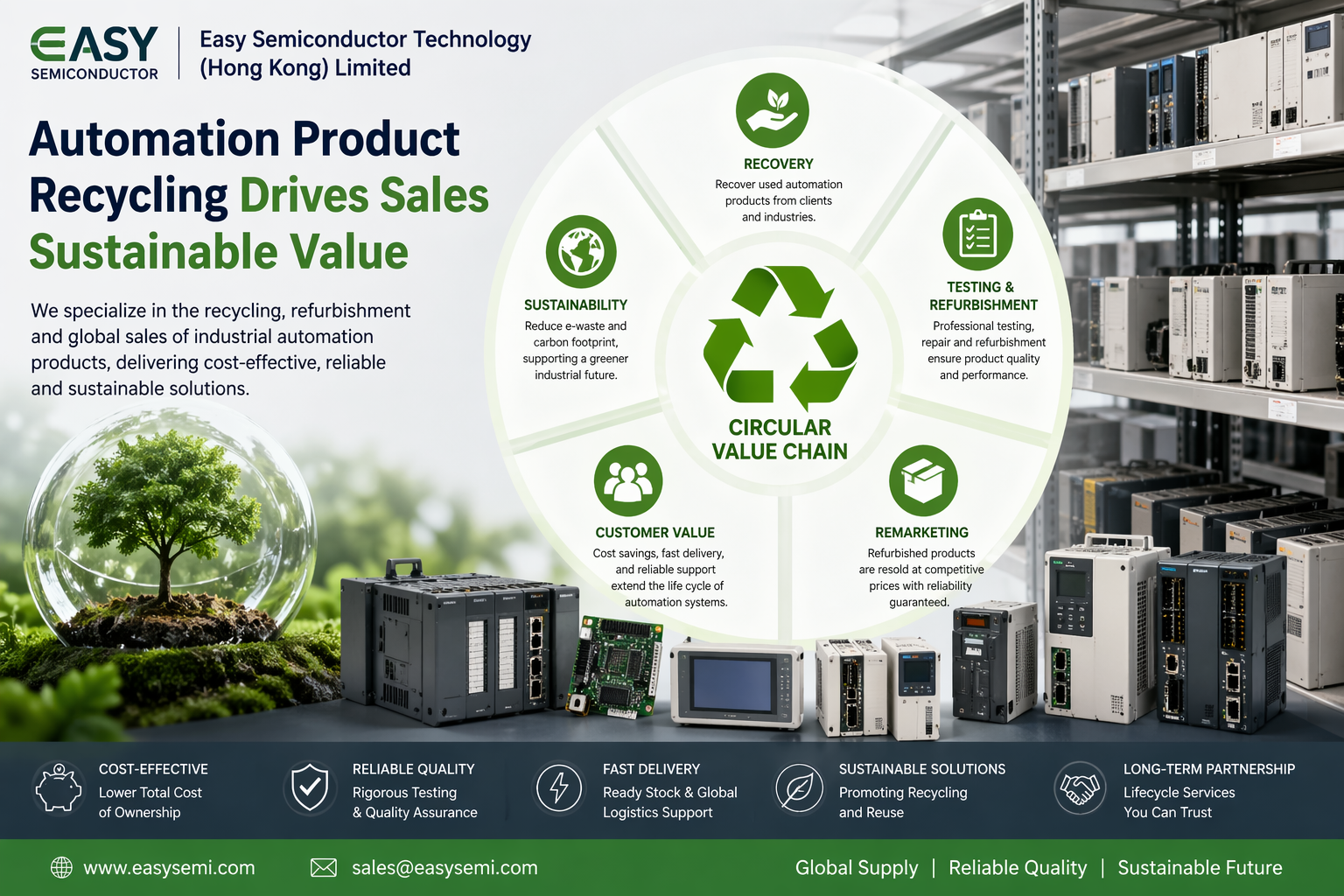
In 2026, the global industrial automation market is undergoing a structural transformation. Traditional linear supply chains are being replaced by circular economy models, where industrial automation product recycling, refurbishment, and resale play a critical role in sustaining growth. For companies engaged in automation trade, integrating recycling with sales is no longer optional—it is a strategic necessity that directly impacts profitability, inventory efficiency, and customer retention.
The concept of a circular economy emphasizes extending the lifecycle of industrial assets. In automation, this includes PLC modules, DCS systems, HMI panels, servo drives, industrial power supplies, and control cards. Instead of discarding used equipment, companies now implement industrial equipment recycling programs to recover value.
Recycling enables businesses to:
Reduce procurement costs
Minimize electronic waste (e-waste)
Reintroduce refurbished components into the supply chain
This creates a sustainable loop where used industrial automation parts become valuable resale assets.
There is a direct commercial linkage between automation product recycling and industrial equipment sales. Recovered components can be:
Tested and refurbished
Certified for reuse
Resold at competitive prices
This approach expands the available product portfolio beyond new inventory. For buyers, especially in cost-sensitive industries, refurbished industrial automation equipment offers a compelling balance between performance and price.
Additionally, recycling enables distributors to:
Maintain stable stock levels during supply shortages
Offer fast delivery for discontinued models
Increase profit margins on refurbished goods
As a result, recycling acts as a sales multiplier, not just a cost-saving mechanism.
One of the biggest challenges in industrial automation is product obsolescence. Many factories still rely on legacy systems from major automation brands, where spare parts are no longer manufactured.
Through structured industrial automation recycling and resale, companies can:
Recover obsolete PLC and DCS modules
Refurbish and reintroduce discontinued components
Support long-term operation of legacy systems
This capability creates a high-demand niche market. Customers are often willing to pay premium prices for rare or discontinued automation parts, making recycling a high-value revenue stream.
Modern buyers expect more than just product supply—they want full lifecycle solutions. Companies that integrate recycling into their business model can offer:
Buyback programs for used automation equipment
Trade-in services for system upgrades
Asset recovery and disposal solutions
These services reduce operational burdens for customers and build long-term partnerships. A closed-loop system—where customers buy, return, and repurchase—creates repeat sales opportunities and strengthens brand loyalty.
Global supply chain disruptions have made it difficult to maintain consistent access to automation components. Recycling provides a strategic advantage by:
Creating an independent secondary supply channel
Reducing reliance on OEM production cycles
Improving inventory turnover rates
With a well-managed recycling pipeline, companies can quickly respond to urgent customer demands, especially for hard-to-find industrial automation parts.
Sustainability is now a key driver in industrial procurement decisions. By promoting industrial automation recycling, companies contribute to:
Lower carbon emissions
Reduced raw material consumption
Decreased electronic waste
This aligns with global ESG (Environmental, Social, and Governance) standards and enhances corporate reputation. Businesses that prioritize green automation solutions are more attractive to environmentally conscious clients and partners.
Advancements in testing and repair technologies have significantly improved the quality of recycled products. Today’s refurbished automation components undergo:
Functional testing
Performance validation
Quality assurance procedures
This ensures reliability comparable to new products, increasing market acceptance and driving higher sales volumes.
Looking ahead, the integration of automation equipment recycling and sales will become a standard industry practice. Companies that invest in:
Reverse logistics systems
Refurbishment capabilities
Digital inventory tracking
will gain a competitive edge in the evolving automation trade landscape.
The relationship between industrial automation product recycling and sales is deeply interconnected. Recycling is no longer just an environmental initiative—it is a core business strategy that drives revenue, enhances supply chain resilience, and supports sustainable growth.
For companies like Easy Semiconductor Technology (Hong Kong) Limited, leveraging recycling alongside sales creates a powerful, future-ready business model. By aligning economic efficiency with environmental responsibility, businesses can unlock new opportunities in the global industrial automation market.