
 home
home
 Published: May 30, 2026 01:38 PM
 Page View: 155
In modern industrial automation systems, Remote I/O (Input/Output) modules play a critical role in extending control capabilities across distributed production environments. By enabling communication between field devices and central PLCs over industrial networks, Remote I/O systems improve scalability, wiring efficiency, and system flexibility. However, communication delays between Remote I/O modules and controllers remain a persistent challenge that can impact real-time performance, production accuracy, and overall system stability.
This article explores the main causes of Remote I/O communication delays and provides practical strategies to diagnose, reduce, and prevent latency issues in industrial automation networks.
Remote I/O communication delay refers to the time lag between a signal being generated at a field device and the corresponding response being received by the PLC or control system. In high-speed industrial environments, even milliseconds of delay can lead to synchronization issues, reduced process efficiency, or unexpected system behavior.
Delays typically occur in industrial networks such as PROFINET, EtherNet/IP, Modbus TCP, and other fieldbus systems used to connect Remote I/O modules to controllers. As factories become increasingly digitized and interconnected, the demand for low-latency communication has become more critical than ever.
One of the most frequent causes of Remote I/O delays is excessive network traffic. When too many devices share the same industrial Ethernet network without proper segmentation, data packets may be queued or retransmitted, increasing latency. High bandwidth usage from non-critical systems can further degrade performance.
Improper network architecture, such as long daisy chains or excessive switch hops, can significantly increase communication time. Each additional node introduces processing delay, which accumulates across the system.
Low-quality or underspecified switches, routers, and Remote I/O modules may not be capable of handling high-speed deterministic communication. This leads to bottlenecks in data processing and transmission.
Industrial environments often contain heavy machinery, motors, and high-voltage equipment that generate electromagnetic noise. EMI can corrupt data signals, causing retransmissions and increased latency.
Misconfigured update rates, packet sizes, or polling intervals can overload the system or reduce communication efficiency. Inconsistent firmware versions between devices can also lead to synchronization issues.
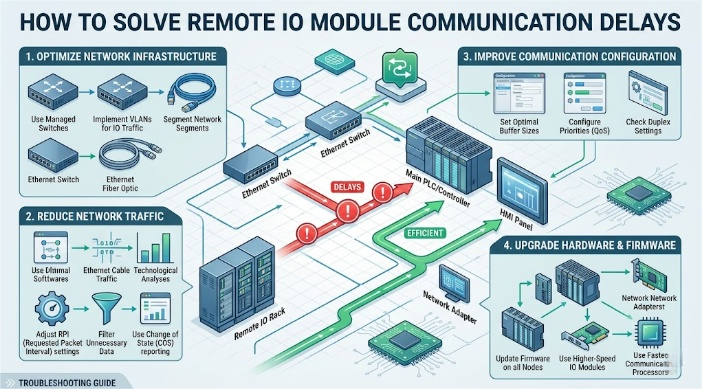
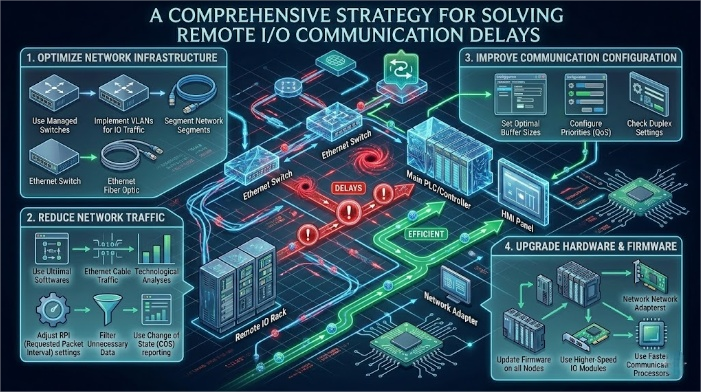
A well-designed network topology is essential for minimizing latency. Star or ring topologies using industrial-grade managed switches are recommended over long daisy-chain configurations. Segregating traffic using VLANs (Virtual Local Area Networks) can isolate critical control data from less important network traffic.
Deploying managed switches designed for real-time industrial communication ensures better handling of deterministic protocols. Features such as Quality of Service (QoS), traffic prioritization, and fast recovery protocols (e.g., MRP, RSTP) help maintain stable communication.
Separating Remote I/O communication networks from general IT networks reduces congestion and improves reliability. A dedicated control network ensures that automation data is not affected by non-industrial traffic such as file transfers or monitoring systems.
Long cable runs increase signal degradation and delay. Using shielded twisted pair (STP) or fiber optic cables can significantly reduce interference and improve transmission speed. Proper grounding is also essential to minimize noise.
Adjusting the scan cycle time of PLCs and Remote I/O modules can help balance system load. Critical signals should be assigned higher priority with faster update rates, while less important data can be updated less frequently.
All devices in the network should operate on compatible firmware versions and standardized communication protocols. Regular updates help eliminate bugs that may cause latency or packet loss.
Edge controllers can process data locally at the Remote I/O level, reducing the amount of data transmitted back to the central PLC. This distributed processing approach significantly reduces communication overhead and improves response time.
Identifying the root cause of Remote I/O latency requires systematic analysis. Common diagnostic tools include:
Network analyzers to monitor packet flow and detect bottlenecks
PLC diagnostics tools to measure scan cycle times and I/O response delays
Industrial protocol analyzers for PROFINET, EtherNet/IP, or Modbus TCP traffic inspection
Real-time monitoring dashboards for continuous performance evaluation
By analyzing these metrics, engineers can pinpoint whether delays are caused by hardware limitations, configuration issues, or network congestion.
To ensure consistent and low-latency Remote I/O performance, industrial operators should adopt the following best practices:
Conduct regular network audits and performance testing
Maintain standardized hardware across automation systems
Implement redundancy in critical network paths
Use industrial-grade components designed for harsh environments
Document and enforce configuration standards across all control systems
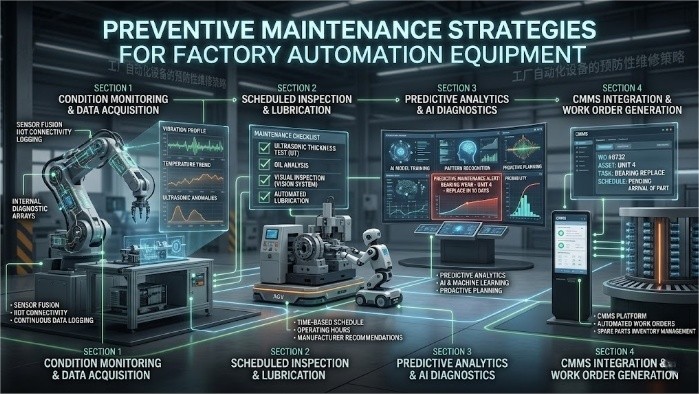
Proactive maintenance and system design optimization are key to preventing communication issues before they impact production.
Remote I/O communication delays can significantly affect industrial automation efficiency, but they are preventable with proper design, configuration, and maintenance strategies. By optimizing network architecture, deploying high-performance hardware, reducing interference, and leveraging edge computing, manufacturers can achieve fast, stable, and deterministic communication across their control systems.
As industrial systems continue to evolve toward greater connectivity and real-time intelligence, minimizing communication latency will remain a core requirement for achieving operational excellence.
Easy Semiconductor Technology (Hong Kong) Limited is committed to delivering advanced automation solutions that enhance industrial communication performance, ensuring reliable and efficient production systems worldwide.