
 home
home
 Published: May 30, 2026 12:57 PM
 Page View: 154
In today's highly automated manufacturing environment, production continuity is critical for maintaining profitability, meeting delivery deadlines, and ensuring customer satisfaction. Unexpected downtime caused by controller failures can result in significant financial losses, disrupted supply chains, and damaged business reputation. As industries increasingly rely on automation systems to manage complex production processes, the demand for highly reliable control architectures continues to grow.
One of the most effective methods for improving system reliability is the implementation of redundant Programmable Logic Controller (PLC) systems. Redundant PLC architectures provide backup control capabilities that minimize production interruptions when hardware or communication failures occur. By incorporating redundancy into industrial automation systems, manufacturers can achieve higher availability, greater operational stability, and enhanced production efficiency.
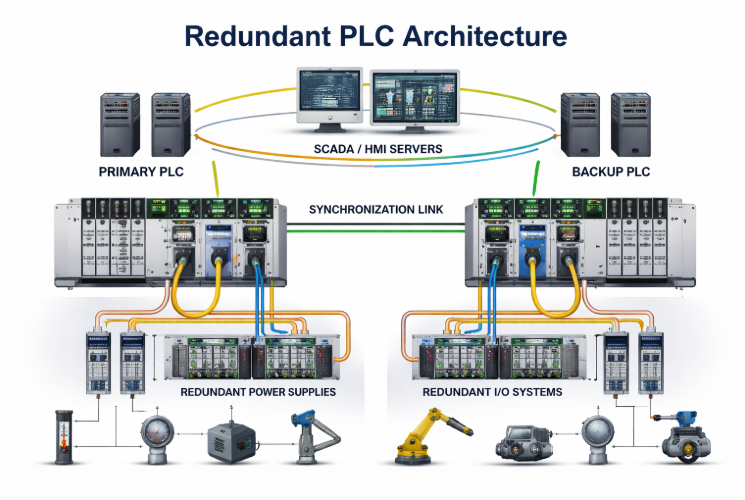
A redundant PLC system consists of two or more controllers operating together to ensure uninterrupted process control. Typically, one PLC serves as the primary controller while another functions as a standby unit. Both controllers continuously synchronize critical process data, operating parameters, and program information.
If the primary controller experiences a fault, the backup controller immediately assumes control of the process without requiring operator intervention. This seamless switchover helps prevent production stoppages and protects equipment from unsafe operating conditions.
Modern industrial automation platforms from major manufacturers support various redundancy configurations, including:
CPU redundancy
Power supply redundancy
Communication network redundancy
I/O redundancy
Server and SCADA redundancy
When properly integrated, these layers of redundancy significantly increase overall system reliability.
Manufacturing facilities often operate around the clock, especially in industries such as:
Semiconductor manufacturing
Chemical processing
Oil and gas production
Pharmaceutical manufacturing
Food and beverage processing
Power generation
Water treatment
In these environments, even a few minutes of downtime can lead to substantial losses. Production interruptions may cause:
Product waste
Equipment damage
Process instability
Missed delivery schedules
Increased maintenance costs
Safety risks
Redundant PLC systems help eliminate single points of failure and maintain stable operations during unexpected events.
The foundation of most redundant control systems is a pair of synchronized PLC processors. The active CPU manages real-time operations while the standby CPU continuously receives updated process information.
When a fault occurs, automatic failover transfers control to the backup processor within milliseconds, ensuring uninterrupted operation.
Communication failures are a common source of industrial downtime. To address this risk, redundant PLC systems often utilize dual Ethernet rings, fiber-optic networks, or parallel communication channels.
If one communication path becomes unavailable, data traffic automatically switches to the alternate route, maintaining connectivity between controllers, I/O modules, and supervisory systems.
Power supply failures can disable an entire automation system. Installing multiple power supplies with automatic load sharing and failover capabilities significantly improves system availability.
Many industrial facilities also combine redundant power supplies with UPS systems and backup generators to achieve maximum reliability.
Input and output modules connect field devices such as sensors, actuators, motors, and valves to the PLC. Failure of a critical I/O module can halt production.
Redundant I/O configurations duplicate critical modules and communication channels, allowing process control to continue even if one component fails.
The most obvious advantage of redundancy is reduced downtime. Automatic failover mechanisms allow production processes to continue without manual intervention.
This capability is especially valuable for continuous-process industries where restarting equipment may take hours or even days.
Redundant architectures increase overall system reliability by removing single points of failure. This results in more predictable production schedules and fewer unexpected disruptions.
Sudden controller failures can leave machinery in unsafe operating states. Redundant PLC systems maintain control during fault conditions, helping protect expensive equipment from damage.
Automation failures may create hazardous situations for personnel. Maintaining control through redundancy reduces the likelihood of accidents caused by process instability.
Although redundant systems require a higher initial investment, the long-term savings associated with reduced downtime often outweigh implementation costs.
Many facilities recover their investment quickly through improved productivity and lower maintenance expenses.
Not every production process requires full redundancy. Manufacturers should first identify systems where downtime would have the greatest operational or financial impact.
Critical applications often include:
Batch processing systems
Continuous production lines
Safety-related controls
Utility infrastructure
High-value manufacturing equipment
Future expansion should be considered during system design. Scalable redundant architectures simplify future upgrades and minimize redesign costs.
A redundant system is only effective if failover functions operate correctly when needed.
Routine testing should include:
Controller failover verification
Network redundancy validation
Power supply testing
Communication diagnostics
Backup restoration procedures
Scheduled testing helps identify hidden issues before they impact production.
Primary and backup controllers should always run identical firmware versions and application programs. Inconsistent configurations can cause synchronization problems and unexpected failover behavior.
Advanced monitoring tools can track controller health, network performance, and hardware status. Predictive maintenance strategies help identify potential failures before they affect production.
Industrial automation continues to evolve rapidly. New technologies are enhancing redundancy capabilities and system resilience.
Key trends include:
Industrial Ethernet redundancy protocols
Edge computing integration
AI-powered predictive diagnostics
Cloud-based backup management
Cybersecurity-enhanced redundancy architectures
Virtualized control environments
These innovations allow manufacturers to achieve even higher levels of availability while simplifying maintenance and system management.
As manufacturing operations become increasingly automated, maintaining continuous production is more important than ever. Redundant PLC systems provide a proven solution for minimizing downtime, protecting critical equipment, and ensuring reliable process control.
By implementing controller, network, power, and I/O redundancy, manufacturers can significantly improve operational resilience and reduce the risks associated with hardware failures. Combined with proper maintenance, regular testing, and modern monitoring technologies, redundant PLC architectures form a critical foundation for high-availability industrial automation.
For organizations seeking maximum productivity and operational reliability, investing in redundant PLC systems is no longer merely an option—it is a strategic necessity for achieving long-term manufacturing success.
About Easy Semiconductor Technology (Hong Kong) Limited
Easy Semiconductor Technology (Hong Kong) Limited specializes in industrial automation components, PLC systems, control solutions, electronic components, and technical support services for manufacturers worldwide. The company is committed to helping customers improve automation reliability, optimize production efficiency, and build resilient industrial operations through advanced technology solutions.