
 home
home
 Published: May 28, 2026 07:45 AM
 Page View: 120
As global manufacturing industries continue accelerating toward digital transformation, many factories still rely on aging production systems that were installed decades ago. While these legacy production lines often remain mechanically reliable, they frequently lack the automation, connectivity, and efficiency required to compete in today’s smart manufacturing environment.
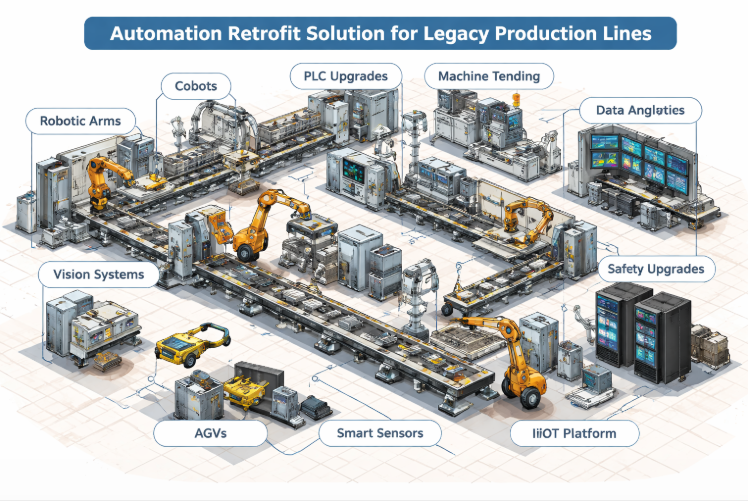
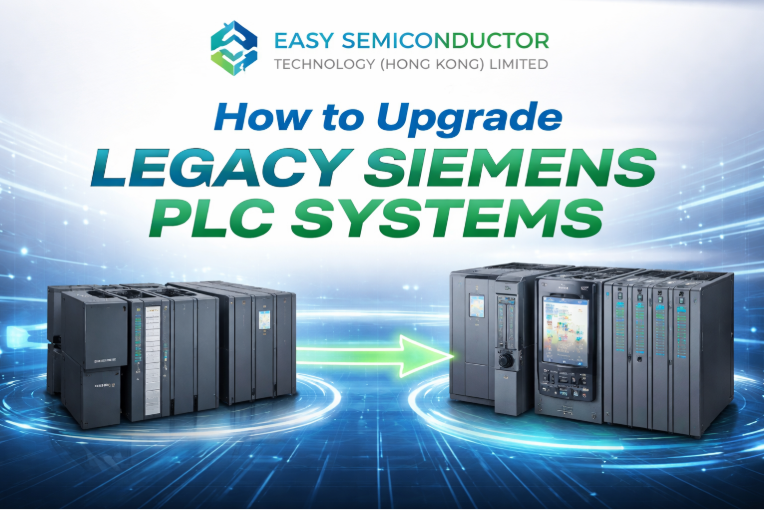
For many industrial operators, completely replacing existing production infrastructure is financially impractical and operationally disruptive. As a result, automation retrofit solutions have emerged as a highly effective strategy for modernizing legacy production lines without requiring full factory reconstruction. Recently, Easy Semiconductor Technology (Hong Kong) Limited successfully completed an automation retrofit project for a large industrial manufacturer in Southeast Asia. The project demonstrated how advanced automation technologies can significantly improve operational efficiency, production visibility, equipment reliability, and long-term scalability while preserving existing manufacturing assets. The customer operated a heavy industrial manufacturing plant specializing in metal processing and mechanical assembly. The facility had been in operation for more than 20 years and relied heavily on conventional control systems and semi-manual production processes. Although the existing equipment remained structurally functional, several operational challenges had become increasingly difficult to manage, including: Frequent production interruptions Limited real-time monitoring capabilities High maintenance costs Inconsistent product quality Low production flexibility Lack of centralized control systems Difficulty sourcing replacement parts for obsolete controllers The plant management team recognized the need for digital modernization but wanted to avoid the enormous capital investment and downtime associated with replacing the entire production line. To solve these challenges, the customer partnered with Easy Semiconductor Technology (Hong Kong) Limited to develop a customized automation retrofit solution designed specifically for the facility’s existing infrastructure. The retrofit project focused on several key operational goals: Improve overall production efficiency Reduce unexpected equipment downtime Modernize outdated control systems Enable real-time production monitoring Improve product consistency and quality Reduce maintenance complexity Extend equipment lifespan Prepare the facility for Industry 4.0 integration The project also required minimal disruption to ongoing production activities during implementation. Before beginning the retrofit process, the engineering team conducted a detailed on-site evaluation of the production facility. The assessment included: Existing PLC and control system analysis Electrical infrastructure inspection Sensor and actuator condition evaluation Production workflow mapping Network architecture review Equipment performance analysis Safety compliance inspection The engineering study revealed that while the mechanical systems remained in acceptable condition, many automation components had become obsolete and lacked compatibility with modern industrial communication standards. Several production areas still depended on relay-based control logic and standalone controllers that limited operational flexibility and diagnostic visibility. Based on the assessment results, the engineering team designed a phased automation retrofit strategy that minimized production interruption while maximizing long-term operational benefits. One of the core elements of the retrofit project involved replacing outdated controllers with modern industrial PLC systems. The upgraded PLC platform provided: Faster processing speed Improved reliability Expanded I/O capacity Better diagnostic capabilities Flexible programming architecture Remote maintenance support The new PLC systems were integrated into existing machinery without requiring major mechanical modifications. To improve operational visibility, the project included the deployment of advanced Human Machine Interface (HMI) panels and centralized SCADA systems. These systems enabled operators to monitor: Real-time machine status Production output Alarm notifications Equipment performance Energy consumption Maintenance alerts Centralized monitoring significantly improved decision-making efficiency and reduced troubleshooting response time. The retrofit solution also included the installation of intelligent industrial sensors across key production areas. Sensors monitored: Temperature Pressure Vibration Position Motor current Conveyor speed Real-time sensor data allowed maintenance teams to identify abnormal operating conditions before major failures occurred. The legacy production line originally relied on isolated control systems with limited communication capability. To modernize connectivity, the engineering team implemented industrial communication protocols including: Modbus TCP/IP Profinet Ethernet/IP OPC UA Industrial Ethernet switches and shielded communication cables were installed to ensure stable network performance in harsh manufacturing environments. Energy monitoring modules were integrated into the electrical distribution system to provide detailed analysis of equipment power consumption. This allowed plant managers to: Identify inefficient equipment Reduce unnecessary power usage Optimize production scheduling Improve energy efficiency The energy monitoring system also supported future sustainability initiatives. Like many retrofit projects involving aging industrial infrastructure, the deployment process presented several technical challenges. Some machinery had been manufactured more than two decades earlier and lacked digital communication interfaces. To solve this issue, the engineering team used custom gateway modules and signal conversion devices to bridge old equipment with modern automation systems. Because the factory operated on a continuous production schedule, installation activities had to be carefully coordinated during planned maintenance windows. The phased implementation strategy successfully minimized operational disruption throughout the upgrade process. The facility’s production environment involved dust, vibration, heat, and electromagnetic interference. To ensure long-term reliability, industrial-grade automation components with reinforced protection ratings were selected for critical deployment areas. Following completion of the automation retrofit project, the customer reported substantial operational improvements within the first six months. Production efficiency improved by approximately 25% due to faster process control, reduced manual intervention, and improved workflow coordination. Unexpected equipment downtime decreased by nearly 40% because predictive monitoring systems enabled earlier fault detection. Automated process control and real-time monitoring significantly improved manufacturing consistency and reduced defect rates. The facility experienced a major reduction in emergency maintenance expenses thanks to improved diagnostics and preventive maintenance capabilities. Centralized monitoring allowed management teams to make faster and more informed operational decisions based on real-time production data. One of the greatest advantages of automation retrofit projects is scalability. The upgraded infrastructure now provides a strong foundation for future technologies including: Industrial Internet of Things (IIoT) Cloud-based monitoring AI-driven predictive analytics Digital twin applications Remote equipment diagnostics Smart factory integration The customer plans to continue expanding automation capabilities across additional facilities in the coming years. Automation retrofit solutions provide industrial manufacturers with a practical and cost-effective pathway toward digital transformation. Instead of replacing entire production lines, manufacturers can modernize existing infrastructure through intelligent automation integration, advanced monitoring systems, and upgraded industrial communication technologies. This successful retrofit project demonstrates how legacy production facilities can achieve substantial improvements in productivity, reliability, operational visibility, and long-term competitiveness through carefully planned automation upgrades. Through advanced industrial automation expertise, reliable component sourcing, and customized engineering solutions, Easy Semiconductor Technology (Hong Kong) Limited continues helping global manufacturers modernize production operations and accelerate the transition toward intelligent manufacturing systems.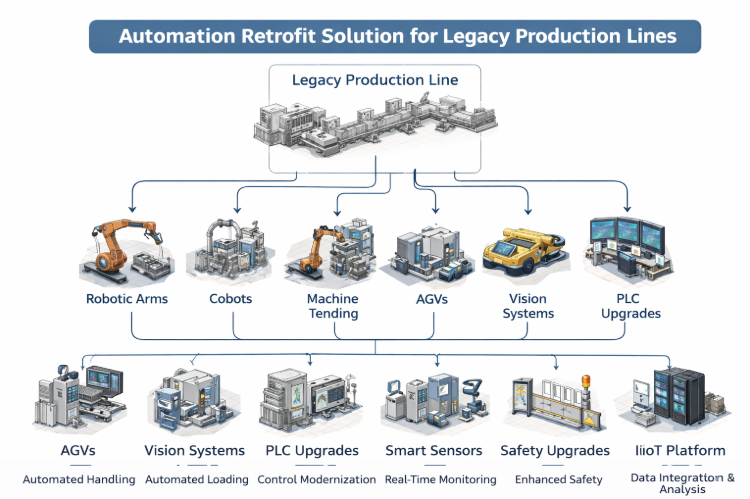
Background of the Legacy Production Facility
Project Objectives
Initial System Assessment
Retrofit Solution Design
PLC System Modernization
HMI and SCADA Integration
Industrial Sensor Deployment
Communication Network Upgrade
Energy Management Integration
Challenges During Implementation
Compatibility with Legacy Equipment
Continuous Production Requirements
Harsh Operating Environment
Project Results
Increased Production Efficiency
Reduced Downtime
Improved Product Quality
Lower Maintenance Costs
Enhanced Operational Visibility
Preparing for Future Smart Manufacturing
Conclusion