
 home
home
 Published: May 13, 2026 09:27 AM
 Page View: 106
Easy Semiconductor Technology (Hong Kong) Limited, a leading global distributor of specialized automation hardware, has released a comprehensive technical report outlining best practices for integrating ABB PLC modules into modern industrial workflows.
ABB’s PLC philosophy is built on the concept of modularity. Unlike fixed-controller systems, ABB modules allow engineers to tailor the hardware specifically to the scale of the operation, whether it is a small-scale packaging line or a massive petrochemical refinery.
"The strength of ABB PLC modules lies in their 'hot-swap' capability and their seamless integration across different communication protocols," says a senior technical consultant at Easy Semiconductor. "For our global clients, the ability to expand a system without shutting down the entire line is a critical competitive advantage."
The first step in any automation project is selecting the correct CPU and I/O modules. The AC500 series is favored for its flexibility and high-speed processing, while the S500 I/O modules provide a wide range of digital and analog options.
Best Practice: Always calculate the total power consumption of the I/O bus to ensure the CPU or power supply module can handle the load.
Environmental Check: For harsh environments, Easy Semiconductor recommends the XC (Extreme Conditions) versions of ABB modules, which are designed to resist vibration, hazardous gases, and extreme temperatures.
ABB PLCs are renowned for their "Communication Neutral" approach. To use these modules effectively, engineers must configure the communication interfaces correctly.
Ethernet & PROFINET: Most modern ABB modules use Ethernet-based protocols for real-time data exchange.
Modbus & PROFIBUS: For legacy system integration, ABB provides dedicated communication modules that bridge the gap between old and new hardware, ensuring data continuity across the plant floor.
The efficiency of an ABB PLC is unlocked through the ABB Automation Builder software suite. This integrated tool covers the engineering of PLCs, safety, drives, and motion.
Standardization: Use the IEC 61131-3 programming standard supported by ABB to ensure code is portable and easy for maintenance teams to troubleshoot.
Simulation: Before deploying to the physical module, utilize the software’s built-in simulation tools to verify logic. This reduces the risk of equipment damage during the commissioning phase.
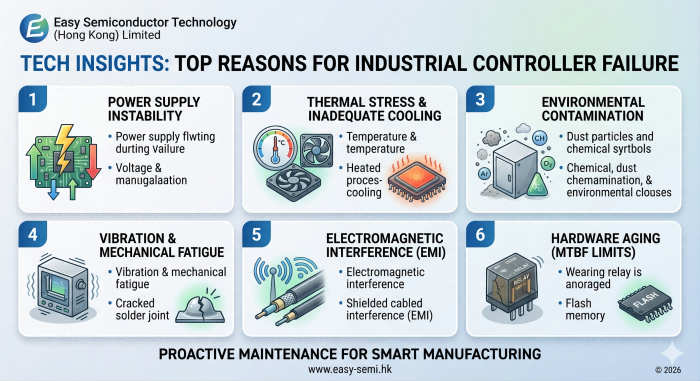
In high-power industrial settings, electromagnetic interference (EMI) can corrupt the data flowing between PLC modules.
The Solution: Easy Semiconductor advises the use of shielded cables for all analog I/O modules and ensuring that the PLC rack is grounded according to ABB’s strict technical specifications.
For mission-critical applications, a single module failure cannot be allowed to stop production.
The Solution: Utilize ABB’s High Availability (HA) configurations. By pairing two CPU modules in a redundant setup, the "bumpless" transfer ensures that if the primary controller fails, the secondary takes over in milliseconds without affecting the process.
A PLC module is a long-term investment. To maximize the lifespan of ABB hardware, Easy Semiconductor Technology (Hong Kong) Limited emphasizes a proactive maintenance schedule:
Firmware Updates: Regularly check for firmware patches from ABB to protect against cybersecurity vulnerabilities.
Module Diagnostics: Use the onboard LED indicators and software diagnostic buffers to identify failing I/O points before they result in a system trip.
Spare Parts Strategy: Given global supply chain fluctuations, maintaining a local stock of critical CPU and I/O modules is essential for minimizing MTTR (Mean Time To Repair).
As industrial automation moves toward the Industrial Internet of Things (IIoT), ABB PLC modules are evolving to include native cloud connectivity and advanced edge computing capabilities. These features allow for real-time data analytics and predictive maintenance, further reducing operational costs.
Easy Semiconductor Technology (Hong Kong) Limited is a premier international supplier of industrial automation components. Based in the global logistics hub of Hong Kong, we specialize in the rapid procurement and distribution of high-end PLC modules, HMIs, and semiconductors from leading brands like ABB, Siemens, and Rockwell.
Our mission is to bridge the gap between advanced technology and industrial application, providing engineers with the genuine parts and technical insights needed to build the factories of tomorrow.