
 home
home
 Published: Apr 09, 2026 02:06 PM
 Page View: 210
HONG KONG, April 9, 2026 — Easy Semiconductor Technology (Hong Kong) Limited, a trusted supplier of industrial automation components and technical solutions, releases a practical guide to Programmable Logic Controllers (PLCs) — the core "brain" of modern industrial automation. This guide breaks down the basics of PLCs, their working principles, practical applications, and key considerations for industrial users, helping engineers, technicians, and procurement teams master PLC technology for optimized production efficiency.
In industrial settings, from small manufacturing workshops to large-scale smart factories, PLCs have replaced traditional relay control systems due to their ruggedness, flexibility, and high reliability. Unlike consumer-grade computers, aProgrammable Logic Controller (PLC) is specifically designed to operate in harsh industrial environments — resisting extreme temperatures (-20°C to +70°C), vibration, dust, and electrical interference, making it ideal for sectors such as manufacturing, robotics, power generation, oil and gas, chemical processing, and automotive production.
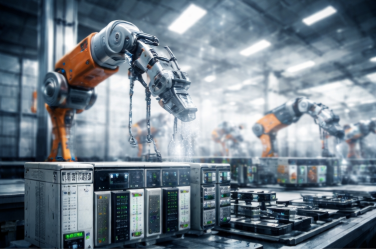
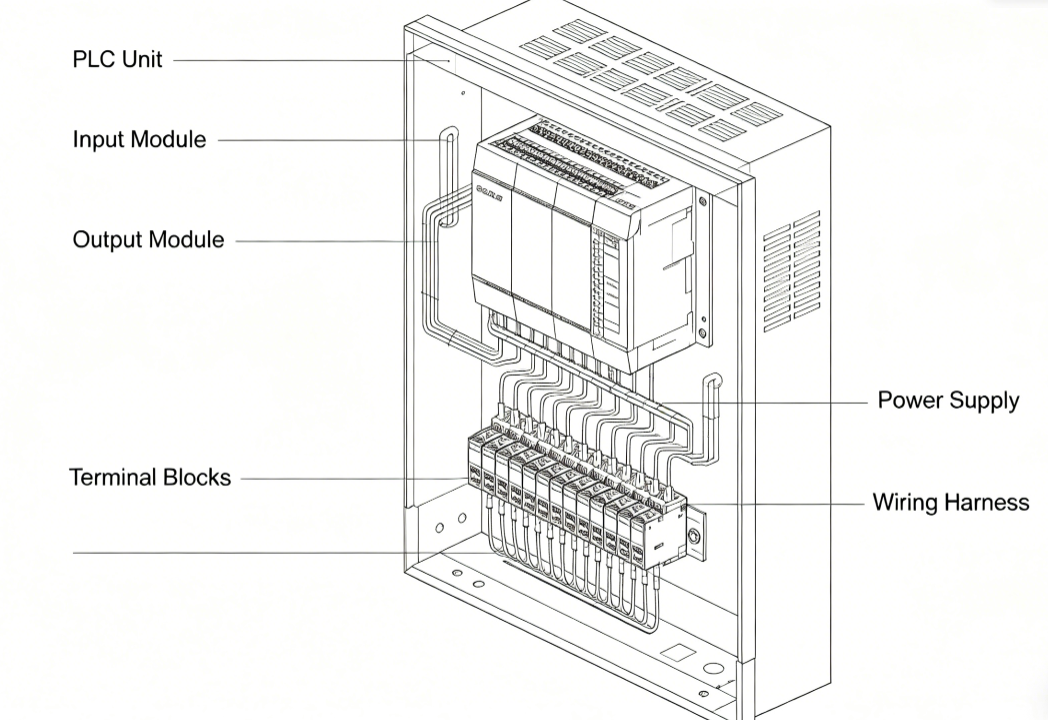
Image 1: Practical PLC Control System Setup (ALT Text: PLC control panel with I/O modules, sensors and actuators for industrial automation) The image shows a real-world PLC control system, including a PLC CPU module, digital/analog I/O modules, a human-machine interface (HMI), and connected field devices (sensors and actuators). This setup is widely used in assembly lines and process control systems, demonstrating how PLCs integrate with other industrial components to achieve automatic control.
To help industrial professionals understand PLCs in practice, we break down their core definition, working mechanism, key components, and practical applications in detail — focusing on actionable knowledge that can be directly applied in on-site operations.
A PLC is a specialized digital computer designed to execute real-time control tasks for machines and industrial processes. Its core function is to receive input signals from field devices, process the signals based on pre-programmed logic, and output control commands to drive equipment — all in a high-speed, continuous cycle. Unlike traditional relay systems, PLCs can be easily reprogrammed to adapt to changes in production processes, eliminating the need for rewiring and reducing downtime.
Image 2: PLC Core Components (ALT Text: PLC CPU module, power supply, I/O modules and communication ports for industrial control)
This image highlights the key components of a PLC: CPU module (the "brain" for logic processing), power supply (providing stable 24VDC/110VAC power), digital/analog I/O modules (connecting to sensors and actuators), and communication ports (PROFIBUS, PROFINET, Modbus) for data exchange with other systems like HMI and SCADA.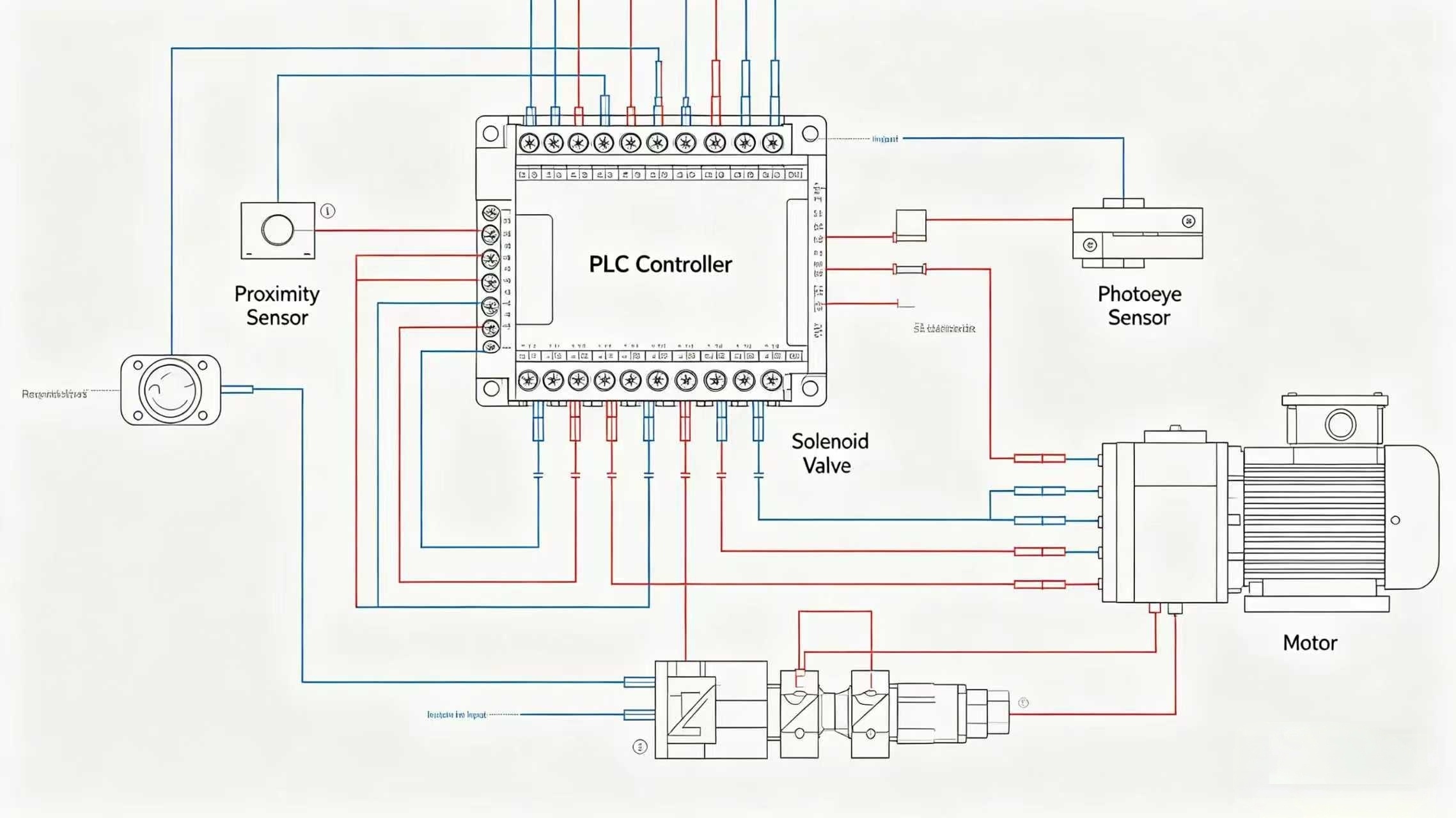
The operation of a PLC follows a continuous scan cycle — typically repeating 10 to 1000 times per second, ensuring millisecond-level real-time control. This cycle consists of three key stages, which are easy to understand and apply in practical operations:
The PLC reads real-time signals from input devices (sensors, limit switches, pressure transmitters, photoelectric sensors, etc.) and stores these signals in its internal memory (input image table). For example, if a photoelectric sensor detects a product on a conveyor belt, it sends a "ON" signal (24VDC) to the PLC’s digital input module — the PLC records this signal as a logic "1" in the input image table.
The PLC’s CPU (Central Processing Unit) executes the user-programmed logic sequentially — the most common programming language is Ladder Logic (LD), which mimics traditional relay circuits and is easy for technicians to learn and debug. Other practical programming languages include Function Block Diagram (FBD) and Structured Text (ST). During this stage, the CPU processes the input signals stored in the input image table and computes the corresponding control commands. For example, if the input signal from the photoelectric sensor is "ON", the CPU executes the logic to start a conveyor belt motor.
Image 3: PLC Ladder Logic Programming (ALT Text: PLC ladder logic diagram for conveyor belt control, practical industrial programming example) The image shows a practical ladder logic program for conveyor belt control — the left side is the input logic (photoelectric sensor signal), and the right side is the output logic (conveyor motor control). This example is widely used in manufacturing workshops, helping technicians quickly grasp PLC programming basics.
After processing the logic, the PLC sends the computed control commands to the output image table, then updates the output devices (actuators, motors, solenoid valves, indicator lights, etc.). For example, the PLC sends a "ON" signal to the output module, which drives the conveyor belt motor to start running. If the input signal disappears (product leaves the sensor), the PLC updates the output to "OFF", stopping the motor — completing a full control cycle.
Understanding the core components of a PLC is essential for on-site maintenance and troubleshooting. Here are the key components and their practical roles:
CPU Module: The core of the PLC, responsible for executing programs, processing input/output signals, and managing communication. Common CPU models include Siemens S7-1200/1500, Allen-Bradley Micro800, and ABB AC500.
Power Supply Module: Provides stable power to the entire PLC system — usually 24VDC (for small PLCs) or 110VAC/220VAC (for large PLCs). It also protects the PLC from voltage fluctuations and short circuits.
I/O Modules: Connect the PLC to field devices. Digital I/O modules handle on/off signals (e.g., sensors, indicator lights), while analog I/O modules handle continuous signals (e.g., pressure, temperature transmitters with 4-20mA signals).
Communication Module: Enables the PLC to communicate with other industrial systems, such as HMI (for operator control), SCADA (for remote monitoring), and other PLCs (for multi-machine coordination). Common communication protocols include PROFINET, Modbus, Ethernet/IP, and PROFIBUS.
Memory: Stores the user program (non-volatile memory, retains data even when power is off) and temporary data (volatile memory, used during program execution).
PLCs are widely used in various industrial fields, with practical applications that directly improve production efficiency and reduce manual intervention. Some common scenarios include:
Manufacturing Assembly Lines: Controlling conveyor belts, robotic arms, and assembly machines to automate product assembly, packaging, and inspection.
Power Generation: Monitoring and controlling generators, pumps, and valves in power plants to ensure stable power supply.
Oil & Gas Industry: Controlling pipeline flow, pressure, and temperature to ensure safe and efficient operation of oil and gas extraction and transportation.
Chemical Processing: Regulating chemical reactions, mixing processes, and wastewater treatment through PID closed-loop control.
Automotive Production: Automating welding, painting, and assembly processes in car manufacturing plants.
Image 4: PLC in Automotive Production (ALT Text: PLC-controlled robotic arm for automotive welding, industrial automation application) The image shows a PLC-controlled robotic arm in an automotive production line — the PLC coordinates the robotic arm’s movement, welding speed, and position, ensuring high-precision and efficient production. This is a typical example of PLC application in modern manufacturing.
As a leading supplier of industrial automation components, Easy Semiconductor Technology (Hong Kong) Limited provides genuine, high-quality PLC modules, spare parts, and technical support for global industrial users. We supply PLC products from top brands such as Siemens, ABB, Allen-Bradley, Schneider, and FANUC — including CPU modules, I/O modules, power supply modules, and communication modules. With our reliable sourcing channels, fast global delivery (covering Europe, the Middle East, and Asia), and professional technical team, we help manufacturers reduce equipment downtime, optimize production processes, and accelerate the transition to smart factories.
"PLCs are the foundation of industrial automation, and understanding their practical working principles is crucial for improving production efficiency," said a spokesperson for Easy Semiconductor. "Our guide is designed to demystify PLC technology, providing practical knowledge that can be directly applied on-site. We are committed to supporting industrial users with high-quality components and professional solutions to meet their automation needs."
Easy Semiconductor Technology (Hong Kong) Limited specializes in the supply, distribution, and technical support of industrial automation components, including PLCs, DCS systems, drives, controllers, power supplies, and robotics spares. Serving manufacturers, system integrators, and maintenance teams worldwide, the company combines reliable product sourcing with professional technical expertise to help clients minimize downtime, optimize operational efficiency, and achieve industrial digitalization.
Media Contact Easy Semiconductor Technology (Hong Kong) Limited Email: info@hongkongeasy.com Website: www.hongkongeasy.com