



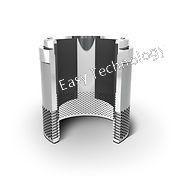
Key Parameters & Specifications Parameter / Feature Category Description Product Name Fisher™ Cavitrol™ III Trim Type Multi-stage, Tortuous Path, Anti-Cavitation & Noise Reduction Trim Primary Function To eliminate cavitation and reduce noise in control valves handling liquids, gases, and steam. Compatible Valve Bodies Designed for use in Fisher sliding-stem globe valves such as the easy-e™ (e.g., D4, EW) and ET series. Operating Principle Breaks a large pressure drop into many small, controlled pressure drops through a series of passages and chambers, preventing the local fluid pressure from dropping below its vapor pressure. Noise Reduction Capability Can achieve noise reduction of 15 to 20 dBA or more compared to a standard single-stage trim. Cavitation Control Designed to operate under conditions where the inlet pressure (P1) minus the outlet pressure (P2) is many times greater than the cavitation inception pressure drop (ΔPc). It allows for a much higher usable pressure drop without damage. Flow Characteristic Modified Equal Percentage (inherent to the trim design). Materials Standard: Hardened 17-4PH stainless steel for excellent erosion resistance. Other materials are available. Size Availability Available for a wide range of valve sizes, typically from 1 inch to 12 inches (DN 25 to DN 300) or larger. Service Applications High-pressure drop water, boiler feedwater, condensate, descaling, pump recirculation, and other cavitating or noisy liquid services.