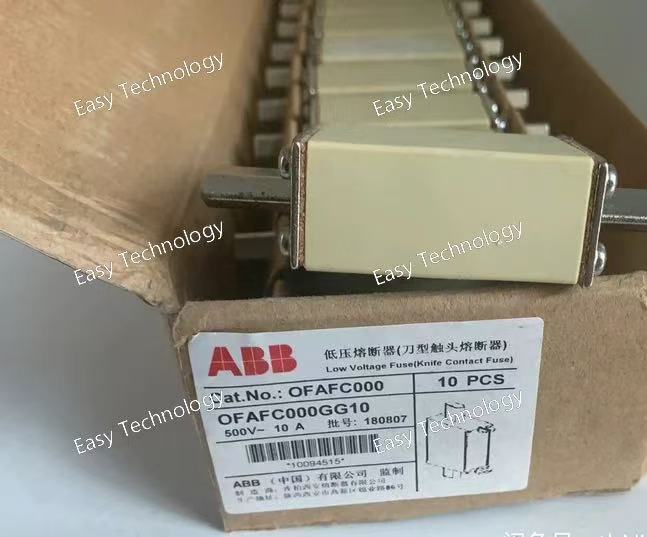
Parameters
Category Parameter Specification for OFAFC000GG10
General Type Electronic, Adjustable, 3-Phase Overload Relay
Series OFAF Series (System Pro M compact®)
Trip Class Class 10 (as per IEC/EN 60947-4-1)
Maximum Setting Current (Iₓ) 10 A (Adjustable range, e.g., 0.4 - 10 A)
Protection Functions Overload Protection Electronic thermal replica with ambient compensation.
Phase Loss Sensitivity Yes. Trips within approx. 5-10 seconds at 100% FLC.
Asymmetry / Unbalance Detects significant phase unbalance.
Locked Rotor Protection Inherent via fast trip on high starting current (typically 6-8 x Iₓ).
Settings & Controls Current Setting Rotary dial, continuously adjustable within range.
Reset Mode Manual (push-button) or Automatic (selectable via a slide switch).
Test Function Integrated TEST button.
Trip Indicator Mechanical flag (red) or LED.
Electrical Characteristics Rated Operational Voltage (Uₑ) Up to 690 V AC, 50/60 Hz (for main circuit isolation).
Control Circuit Voltage Limited by auxiliary contacts; typically ≤ 600 V AC/DC.
Power Consumption Negligible (self-powered from current sensors).
Auxiliary Contacts Trip Contact (95-96) 1 NO (Normally Closed) – Breaks contactor coil circuit.
Alarm/Signal Contact (97-98) 1 NO (Normally Open) – Makes on trip for remote indication.
Contact Rating Typically AC-15: 6 A at 230 V; DC-13: 0.3 A at 230 V.
Current Sensors Type Integrated Current Transformers (CTs).
Continuous Withstand 1.2 x Iₓ (Max Setting) continuously.
Mounting & Connection Mounting 35 mm top-hat DIN rail (EN 60715).
Main Terminals Screw clamp for motor/load connection. Accepts 1.5 - 4 mm² cable.
Auxiliary Terminals Screw clamp for control wiring. Accepts 0.5 - 2.5 mm² cable.
Environmental Operating Temperature -25°C to +60°C (calibrated at +40°C)
Storage Temperature -40°C to +70°C
Altitude Up to 2000 m without derating
Pollution Degree PD 2
Protection Degree IP20
Physical Dimensions (W×H×D) Approx. 45 x 90 x 70 mm (varies by model)
Weight Approx. 0.2 kg
Standards Compliance IEC/EN 60947-4-1, UL 508, CSA C22.2 No. 14