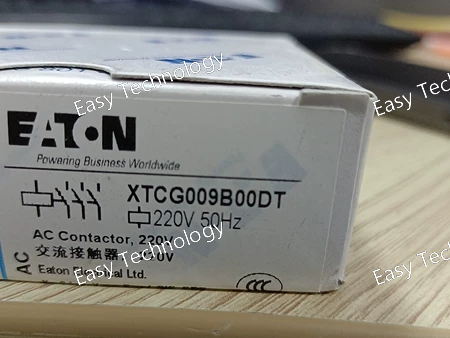
Key Parameters
1. Compatibility & Mounting:
Compatible Breaker Series: Designed for Eaton XT series circuit breakers. It is a plug-in/retrofit module that replaces the standard thermal-magnetic or basic electronic trip unit on compatible breaker frames.
Mounting: Integrates directly into the breaker housing.
2. Protection Functions (Key Settings):
Long-Time Protection (L):
Function: Protection against overloads.
Adjustable Parameters: Current Setting (Ir) – typically adjustable from 0.4 to 1.0 x In (where In is the trip unit's rated current, e.g., 800A for a matching breaker). Time Delay (tr) – adjustable.
Short-Time Protection (S):
Function: Protection against short-circuits with a time delay for selectivity.
Adjustable Parameters: Current Setting (Isd) – adjustable (e.g., 1.5 to 15 x Ir). Time Delay (tsd) – adjustable, usually in I²t mode (constant energy) or definite time.
Instantaneous Protection (I):
Function: Protection against high-magnitude short-circuits (no intentional delay).
Adjustable Parameter: Current Setting (Ii) – adjustable (e.g., 1.5 to 15 x Ir, or fixed multiples).
Ground-Fault Protection (G):
Function: Protection against earth leakage currents.
Adjustable Parameters: Current Setting (Ig) – adjustable. Time Delay (tg) – adjustable.
Sensing: Requires an external ground-fault current sensor (core balance CT).
3. Display & Interface:
Display Type: High-resolution, backlit LCD graphical display.
Interface: Navigation buttons for local programming, configuration, and real-time monitoring of electrical parameters.
Local Indication: Shows status (ON/OFF/TRIPPED), measured values, and fault alerts.
4. Measured & Monitored Values (Real-Time):
Displays phase currents (IL1, IL2, IL3), neutral current (In), ground-fault current (Ig).
Voltage (line-to-line and line-to-neutral), frequency, power (kW, kVAR, kVA), power factor, energy (kWh).
5. Communication & Integration:
Built-in Communication: The DT variant is typically equipped with a communication board.
Standard Protocols: Commonly supports Modbus RTU (RS-485) as a standard or frequently included option.
Function: Enables integration into SCADA, Building Management Systems (BMS), or industrial networks for remote monitoring, control, data logging, and event/alarm management.
6. Power Supply:
Auxiliary Power Source: Requires a separate, continuous 24-48V DC or 110-230V AC/DC auxiliary power supply (depending on the exact model configuration) to operate its electronics, display, and communication functions. It draws its sensing power from the internal current transformers (CTs) in the breaker, but the electronics need this external supply.
7. Certifications & Standards:
Complies with international circuit breaker standards such as IEC 60947-2, UL 489, and relevant communication standards.
8. Typical Applications:
Main and sub-distribution switchboards in commercial buildings, data centers, and industrial plants.
Protection of feeders, generators, and large motors where adjustable, selective coordination and system monitoring are required.
Critical power systems requiring remote visibility and control.